







Material is the last thing most people decide and the first thing they regret. The reason is that frame material is usually presented as a taste question — acetate looks warm, metal looks clean — when it is actually a set of five measurable trade-offs. Answer the five questions below in order and the material stops being a matter of opinion.
None of them require you to know anything about manufacturing. They only require you to look at your prescription, your nose and the pair you are wearing now.
Question 1: how thick is your lens edge?
Not the power — the edge. A −2.00 lens in a 52 mm frame has a thin edge and will look tidy in anything. A −6.00 lens in the same frame has an edge you can see from the side, and the rim either covers it or advertises it. Metal rims are around a millimetre deep; acetate rims are four to six. That single difference decides whether the frame looks calm or busy at the edge, and no amount of styling compensates for it.
If you are not sure how much edge you will have, the honest sequence is: choose a small, shallow lens, then choose a high-index material to reduce the edge further, then choose a deep rim to hide whatever is left. Question one is the one that rules out options, so answer it before you fall in love with a photograph. Why rim depth varies by material in the first place is set out in acetate versus plastic frames.
Question 2: how much rim do you want to see?
This is the taste question, but it has a measurable answer. Hold a metal frame and an acetate frame side by side at arm’s length. If the metal one looks underdressed and the acetate one looks like a mask, you have your answer. If both look fine, you are free to let questions three to five decide.
It is worth knowing that this is not a pure preference. Rim depth changes how much of the frame sits in your peripheral vision. People who read for hours often prefer a shallow lens with a thin rim for exactly that reason, and people who wear the frame as part of how they look tend to want the opposite.

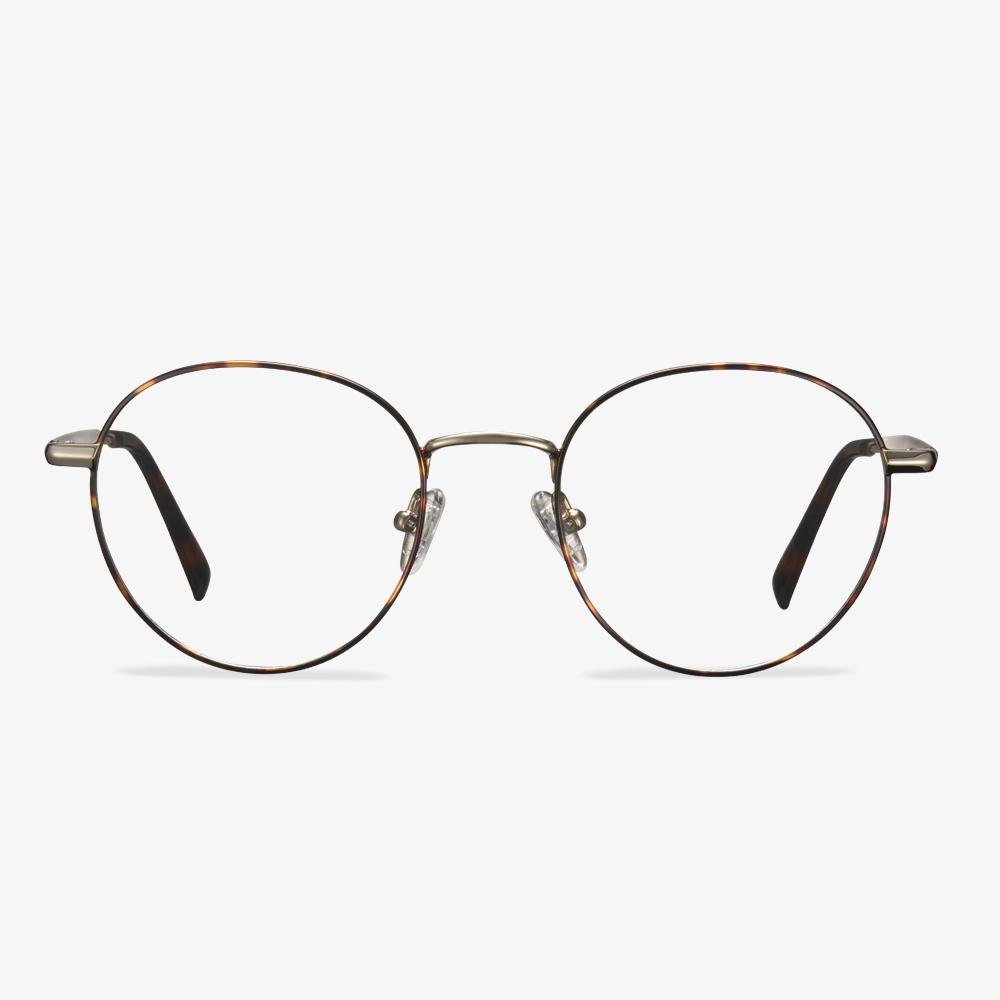
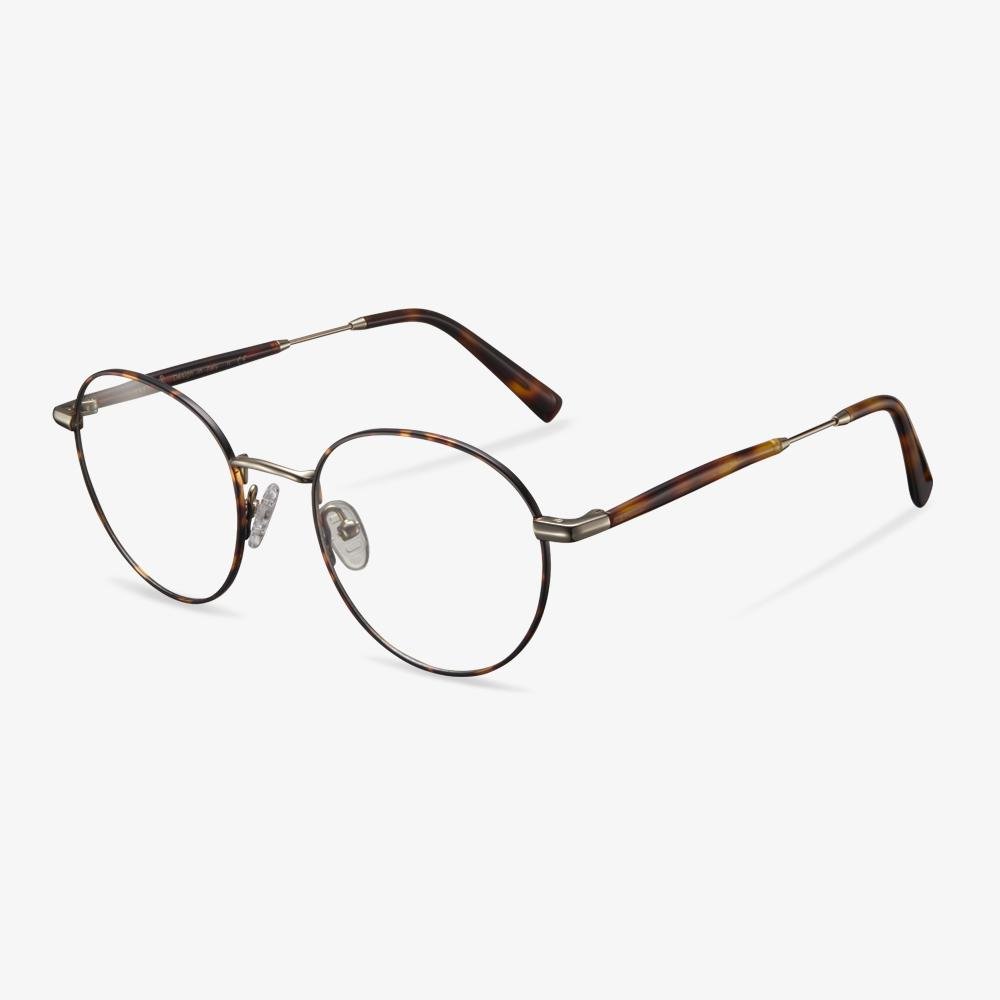
A 138 mm round in brown tortoise acetate — 48 mm lens, 43 mm lens height, 22 mm bridge, 145 mm temple — the smallest front in this article, which is what makes it read as a frame rather than as a mask.
Frame width 138 mm · Lens 48 × 43 mm · Bridge 22 mm
The Mesa is also the clearest illustration of why lens size and rim depth should be decided together. A 48 mm lens inside a deep round rim leaves very little lens edge exposed at any angle, so the same prescription that looks busy in a wide rectangle looks tidy here.
Question 3: does your nose tolerate pressure?
Metal frames carry their mass on two small pads. Acetate frames spread it across the moulded bridge. If you already know that you get marks, or that a metal frame has to be pushed back up every hour, question three has answered itself: go acetate, or go combination with a metal front light enough that the pads barely load.
Bridge width matters as much as the material here, and it is the number people skip. In the acetate frames below the bridge runs from 17 mm to 28 mm — an 11 mm range inside one material, which is more variation than the difference between acetate and metal.
Question 4: is colour part of the decision?
Metal gives you finishes: gold, silver, gunmetal, black. Acetate gives you blocks: opaque, tortoise, translucent, and laminations where several colours are pressed into one sheet. If you want the frame to be a neutral line, metal has nothing to apologise for. If the colour is half the reason you are buying, acetate is the only material with enough range — and translucent finishes will also show the internal structure of the frame, which is beautiful on a moderate prescription and less so on a strong one.

A 142 mm frame in translucent gold — 50 mm lens, 44 mm lens height, 22 mm bridge — the clearest demonstration in this article of what translucency does to a lens edge in daylight.
Frame width 142 mm · Lens 50 × 44 mm · Bridge 22 mm
Look at that card and imagine a thick edge behind it. That is the whole risk of translucent colour in one image, and it is the reason question one comes before question four.
Question 5: how often will this frame be adjusted or repaired?
Acetate can be heated and reshaped, and a hinge can be re-riveted. Metal can be bent, and bending works the material a little every time. If you are hard on glasses — sport, kids, a bag without a case — the frame that survives is usually the one with the simplest joint, and the frame that stays comfortable is the one an optician can reshape rather than bend.
The comparison, compressed
| What you are weighing | Acetate | Metal | Combination |
|---|---|---|---|
| Rim depth in front of the lens | 4–6 mm, hides the lens edge | About 1 mm, shows the edge | Depends: metal front or acetate front |
| Typical weight in this collection | 20 g to 30 g | 18 g and up | 18 g with a metal front |
| Colour range | Opaque, tortoise, translucent, laminated | Finishes only | Colour front with metal hardware, or the reverse |
| Where the load sits | Spread across the moulded bridge | Two adjustable nose pads | Depends on which part is metal |
| Adjustment method | Heat and reshape | Cold bend | Both, on the same frame |
| Strong prescription at the edge | Best cover | Least cover | Good if the front is acetate |
| Repair outlook | Re-riveting, re-polishing | Hinge plate replacement | The joint is the weak point |
Read the table by rows, not columns. If row one and row six are the rows that matter to you, acetate wins and the rest is detail. If row three is the row you care about, you already knew the answer before you started.
What the test usually returns
For most prescriptions in the moderate range, with a face that has been hard to fit before, the test returns acetate — not because it is better, but because it is the only material that covers the lens edge, holds colour and can be reshaped. The frame below is the version of that answer most people end up with: a full-rim acetate round with enough depth to hide a moderate-to-strong edge and a keyhole bridge that sits well on a nose that has been difficult.

A 142 mm round in chunky black acetate at 28 g — 50 mm lens, 44 mm lens height, 22 mm bridge, keyhole nose bridge, full rim.
Frame width 142 mm · Lens 50 × 44 mm · Bridge 22 mm
The keyhole bridge is worth a sentence of its own. It is the open, key-shaped cut-out that lets the frame sit on the sides of the nose instead of on top of it, which is why it feels different from a solid bridge of the same width. On a nose with a pronounced bridge it is often the difference between “these fit” and “these slide”.
If your prescription is light and your priority is colour rather than cover, the test returns a translucent or oversized acetate instead — a different answer from the same material.

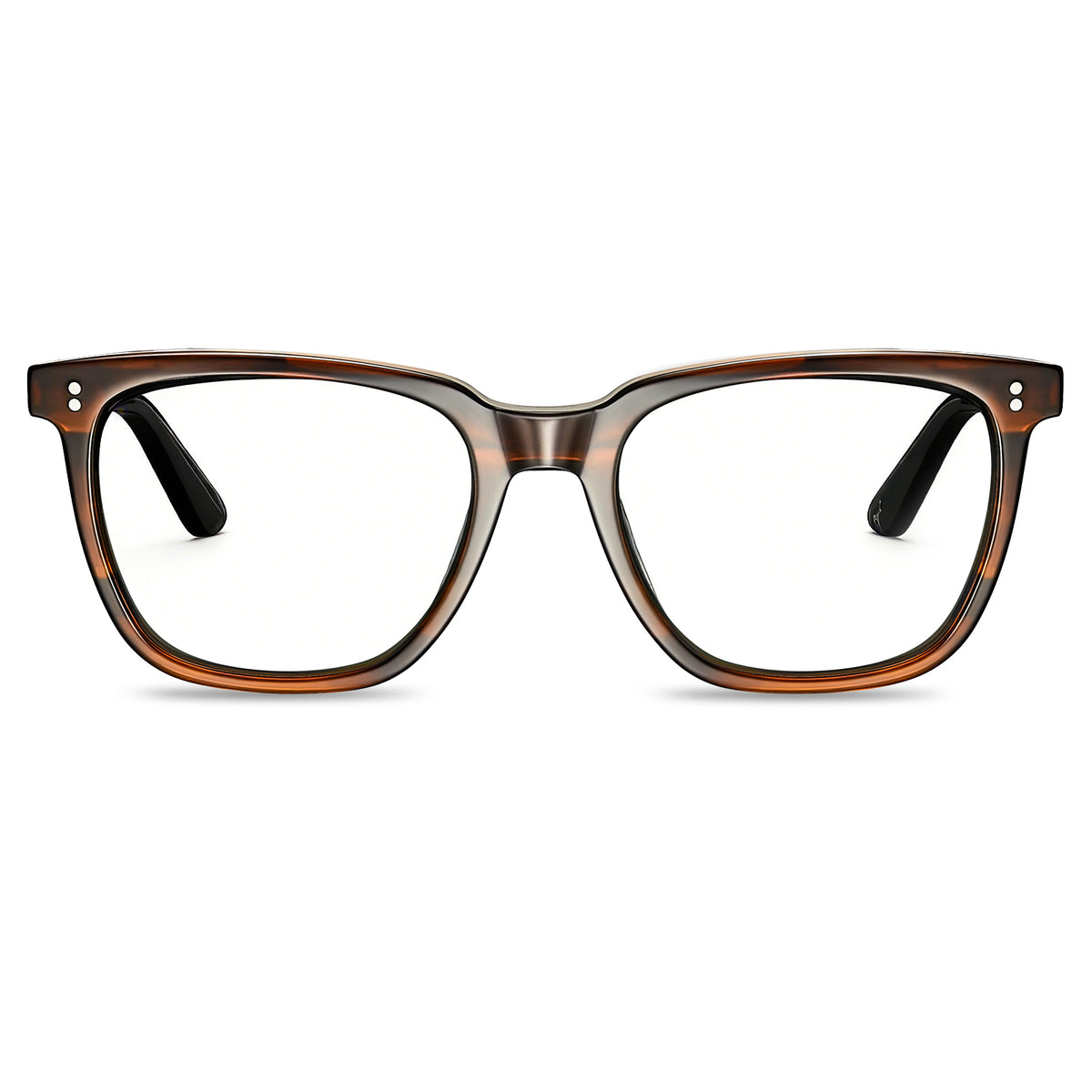
A 142 mm oversized square in transparent grey Italian-design acetate at about 23 g — 55 mm lens, 40 mm lens height, 17 mm bridge.
Frame width 142 mm · Lens 55 × 40 mm · Bridge 17 mm
And if the edge is genuinely thin — a low prescription, a small lens, or both — the test is allowed to return metal, because there is nothing to hide.

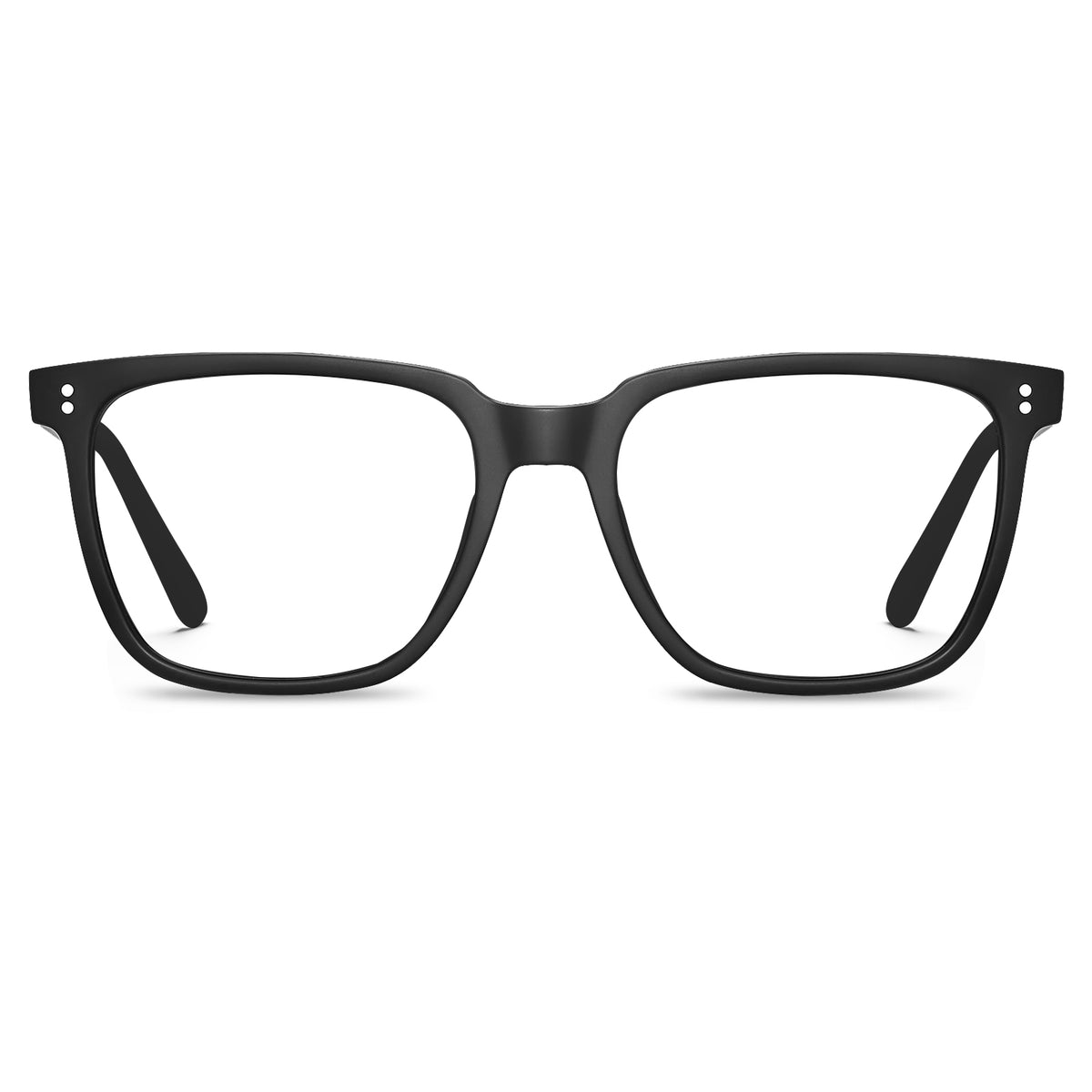
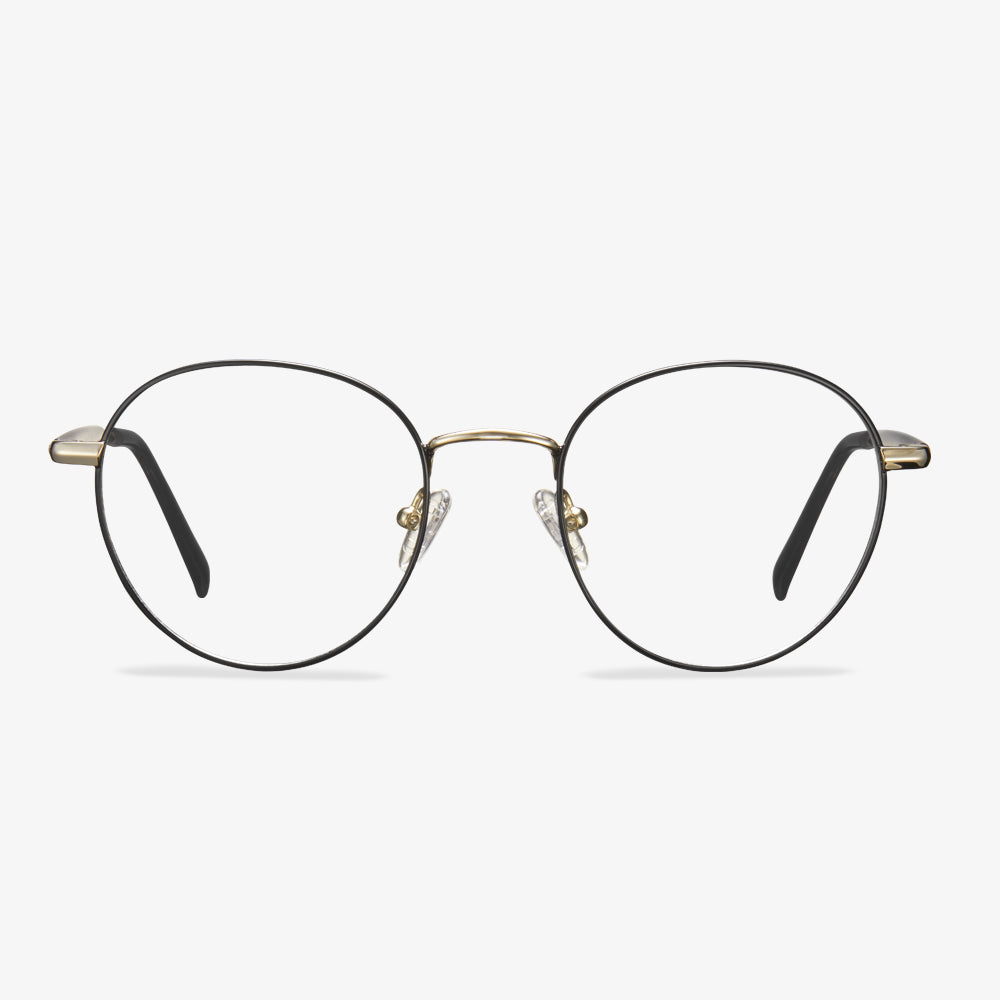
A 141 mm full-rim metal rectangle in black — 58 mm lens, 45 mm lens height, 16 mm bridge, the widest lens and narrowest bridge in this article.
Frame width 141 mm · Lens 58 × 45 mm · Bridge 16 mm
Two answers that are easy to get wrong
The first is buying translucent acetate with a strong prescription and being surprised that the edge is visible. The material is doing what it does; the lens is the variable. If you want translucency and a strong prescription, keep the lens small and ask for high index — the reasoning is in the high-index advantage.
The second is choosing a frame width from a photograph. Material will not fix a front that is 8 mm too wide, and a wider frame also means more lens, which means more edge, which pushes you back toward acetate. Measure the pair you own, then compare: how to measure frame size takes about two minutes.
Where to apply the answers
If questions one, three and five pointed at acetate, browse acetate eyeglasses and use the shape filter rather than the colour filter first. If question two was the deciding one and you wanted the frame to disappear, metal eyeglasses is the shorter path. If you are still deciding what the lens itself should be — single vision, progressive, blue-light, high index — how to choose eyeglass lenses covers that decision separately, and it changes what the frame has to hide.
Then compare the two shortlists in the full eyeglasses collection, where the same shape appears in more than one material. That side-by-side is the only test that beats reading about material, because it is the one where you are looking at your own face.