







Tinted vs Polarized: A 60-Second Check Before You Buy
The word 'polarized' appears on a very large share of sunglasses listings and is verified on a much smaller share of them. In most markets it is a descriptive claim rather than a certified one — unlike UV400, which refers to a measurable optical property. That gap is where a tinted lens gets sold as a polarized one, and it is why a physical check is worth more than a specification sheet.
This piece is about buying, not about physics. Three checks that take under a minute, the four numbers on the inside of the temple, and what to walk away from.
Two mechanisms, one word apart
A tinted lens reduces the total amount of light passing through it. A polarized lens also contains a filter that blocks light vibrating in one plane, usually the horizontal one, which is the plane most reflected glare arrives in.
A lens can be both, either, or neither in any combination. Very dark and not polarized is common at low price points. Lightly tinted and fully polarized is common in driving and sports eyewear. The two properties are independent, and only one of them is easy to fake.
Check 1 — the phone screen, 30 seconds
Open a white screen on a phone or laptop. Hold one lens in front of it and rotate the frame slowly through 90 degrees.
- Polarized: the screen darkens dramatically at one angle, often to near-black, and clears again at 90 degrees.
- Tinted only: the screen dims evenly and stays dim. It never goes black at any angle.
This works because LCD displays emit polarized light. It is the single most reliable test available without equipment, and it takes less time than reading the label.
The longer walkthrough — including how to check a pair that has no packaging and no specification left — is in how to tell whether sunglasses are polarized. If you want the mechanism behind the test rather than the test itself, here is what a polarized lens actually does.
Check 2 — cross two pairs
If you own one pair you trust, put the two lenses together and look through both, then rotate one frame. Two polarized lenses crossed at 90 degrees block almost all light. If the stack never goes dark, at least one of the two is not polarized.
This is also the fastest way to check a pair you are buying second-hand, where the original packaging and specification are gone.
Check 3 — read the specification, not the sticker
A sticker on the lens can say anything. What matters is the specification line on the product page or the box, and it should contain two separate statements:
- UV400 — blocks ultraviolet radiation up to 400 nm, covering UVA and UVB. This is the one that protects your eyes, and it applies whether or not the lens is polarized.
- Polarized — a filter that removes horizontally reflected light. This is the one that removes glare.
- Optional third: a lens category, from 1 (light) to 4 (very dark, not for driving). For everyday daylight use, Category 3 is the sensible default.
A dark lens with no UV400 statement is the worst combination on the market: the tint relaxes your pupil while ultraviolet light passes through. If a listing will not state UV protection, it has not promised you any.
The numbers inside the temple, decoded
Almost every frame carries three numbers, often written like 53 □ 19 145. They are not interchangeable, and knowing which is which explains most fit problems.
| Number | Name | What it controls |
|---|---|---|
| 53 | Lens width (mm) | Width of one lens. Drives how much of your field of view is covered and how the frame reads on the face. |
| 19 | Bridge (mm) | Gap between the lenses. Too narrow pinches the nose, too wide sits low and slides. |
| 145 | Temple length (mm) | Arm length to the bend. Too short pulls on the ears, too long pushes the frame forward. |
| — | Total frame width (mm) | Hinge to hinge. Rarely printed on the frame; the number that decides whether a pair stays put. |
There is a fourth number that rarely appears on the frame but matters most: total frame width, measured across the front from hinge to hinge. If your current pair measures 140 mm and fits, a 147 mm front will feel loose no matter how good the lens is. The frame measurement guide shows how to measure all four at home.
Four things a polarized lens will not do
- It will not replace UV protection. They are separate specifications, and a polarized lens without UV400 is still a lens that lets ultraviolet through.
- It will not fix a bad fit. A front that is too wide slides down, and a sliding frame is worn less, whatever the lens can do.
- It will not work at night. A day lens removes light you need after dark. Keep a clear pair for night driving.
- It will not rescue a scratched lens. If a scratch reaches the filter layer, the lens shows a bright line in low sun and cannot be polished out.
Five frames that pass all three checks
Everything below is from the twelve best-selling Carfia sunglasses across 2025–2026: all full-rim, all carrying a polarizing filter, and all stating UVA/UVB protection up to 400 nm on the product page. Measured lens widths, bridges and frame widths are listed under each card — pick on fit first, colour second.

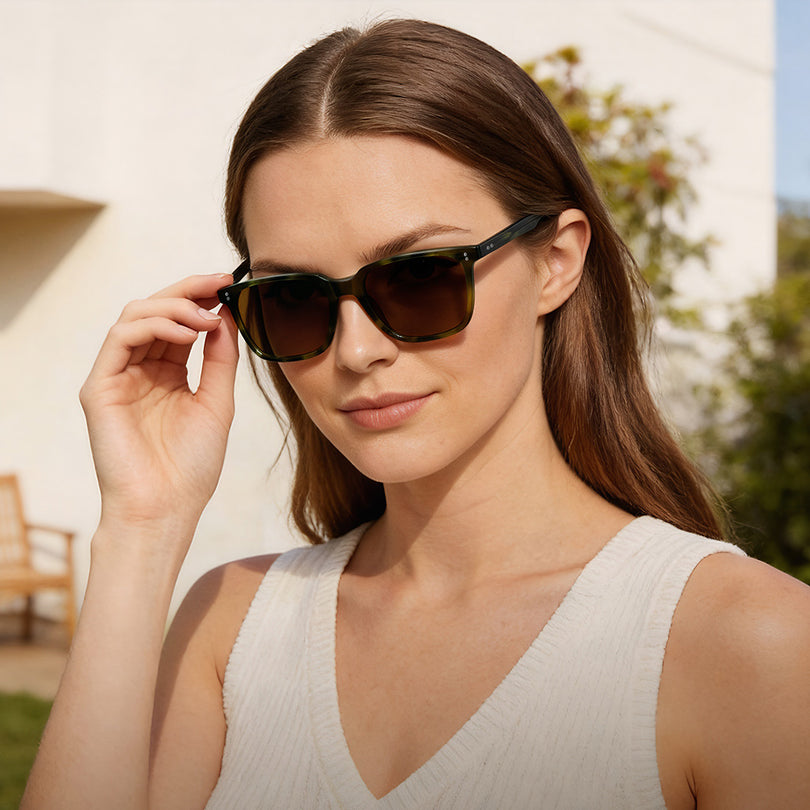
A 48 mm lens on a 138 mm acetate front, which is the compact end of the range and the reason this shape works on smaller faces as well as larger ones. Green lens, full-rim acetate. If you have tried sunglasses that felt like they were wearing you rather than the other way round, this is the size to compare against.
Polarized · Frame width 138 mm · Lens 48 mm · Bridge 22 mm

Round acetate, 51 mm lens, 138 mm front, grey lens. A narrow 17 mm bridge suits a smaller nose bridge, and the round shape keeps a compact frame from looking severe. This is the pair to test on the phone screen if you want to see how emphatic the effect is: face a window, hold it up, rotate.
Polarized · Frame width 138 mm · Lens 51 mm · Bridge 17 mm

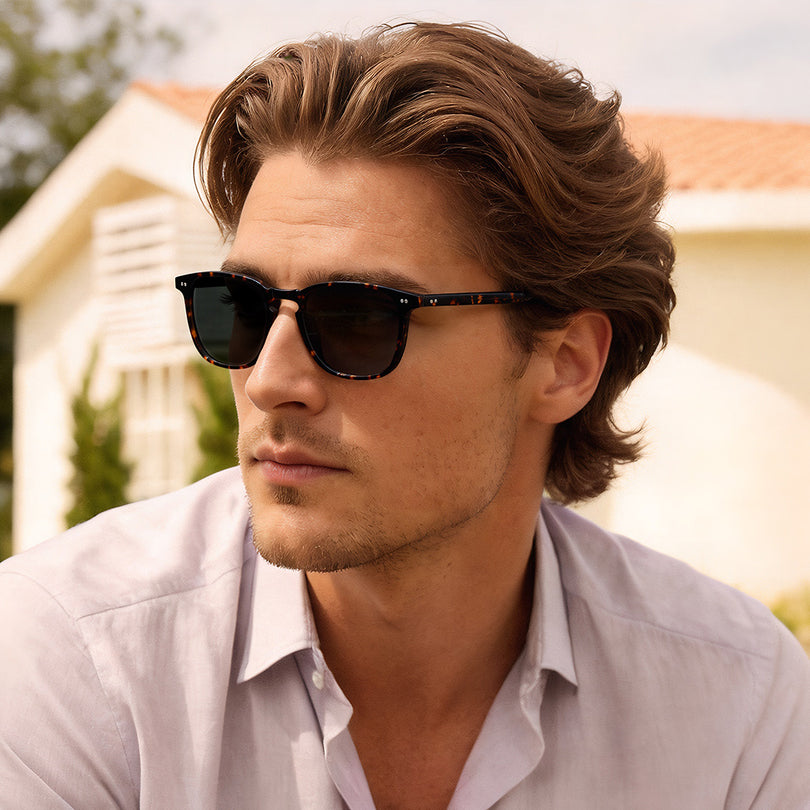
Carfia's best-selling frame, and the one we would point a first-time polarized buyer towards. 53 mm lens, 19 mm bridge, 142 mm front, brown striped acetate, green lens. Wide enough to shade the eye properly without sitting on the cheekbones.
Polarized · Frame width 142 mm · Lens 53 mm · Bridge 19 mm

A compact women's frame with a 46 mm lens and a 23 mm bridge — the widest bridge here, for a higher or broader nose bridge. Amber lens. Worth calling out for anyone who has been told that a 'small face' means a narrow bridge: it usually means a shorter lens width, not a narrower bridge, and this frame is the proof.
Polarized · Lens 46 mm · Bridge 23 mm

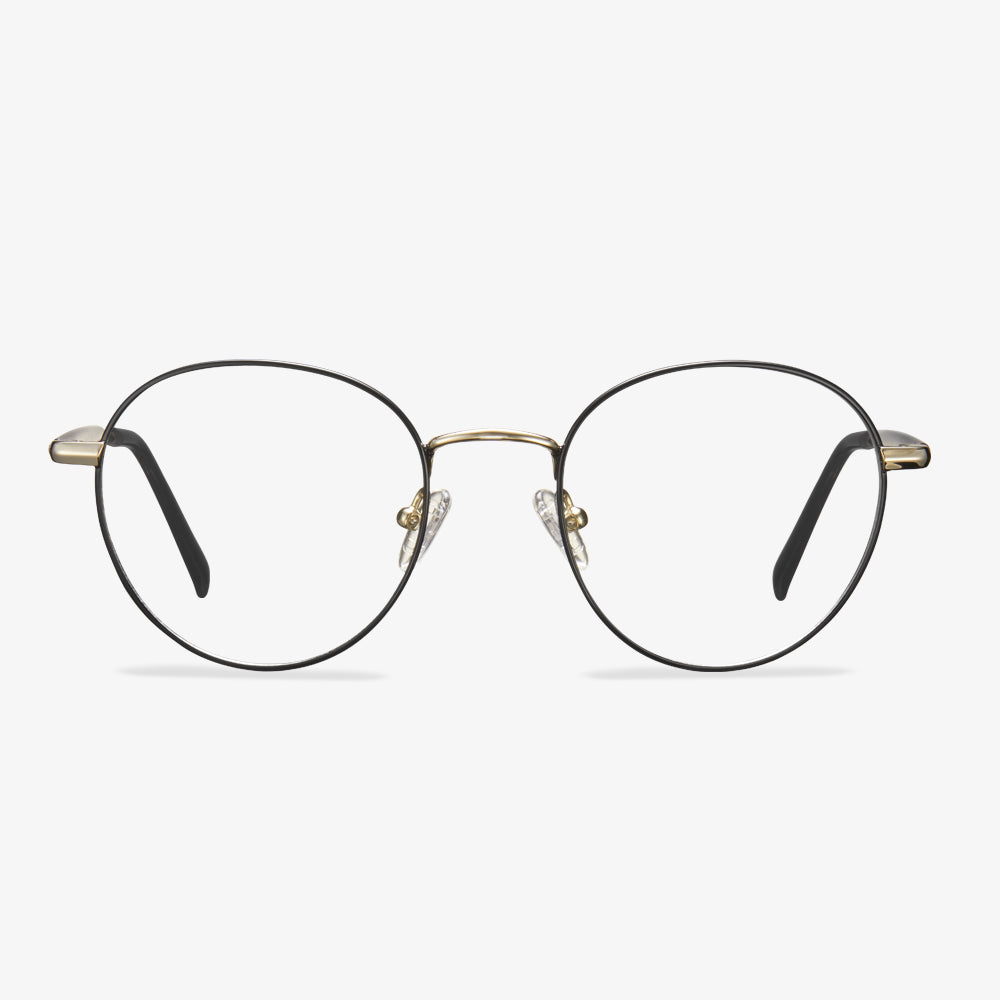
The metal frame, and the one with the most interesting construction detail: a 58 mm lens on a 140 mm front, full-rim, built without a laminated film in the lens. That matters because film-based polarized lenses are the ones that eventually delaminate at the edge. A slimmer metal rim also puts less weight on the bridge than an acetate front of the same coverage.
Polarized · Frame width 140 mm · Lens 58 mm · Bridge 16 mm
A buying order that avoids the usual mistake
- Decide the job: daylight driving, water, snow, or everyday. That decides the lens colour before anything else.
- Measure a pair you already like. Write down lens width and total frame width. This is the constraint, not the style.
- Run the phone-screen check on the pair in front of you, or read the specification if you are buying online.
- Confirm UV400 as a separate line. If it is missing, stop.
- Only then look at the colourway. It is the last decision, not the first.
Our lens overview lists what each Carfia lens is specified to do, and the tinted lens page covers the non-polarized options if you want colour without a filter.
Frequently asked
How can I tell if my current sunglasses are polarized?
The phone screen test is definitive. Rotate one lens in front of a lit LCD; a polarized lens blacks the screen out at one angle, a tinted lens only dims it. If you have two pairs, crossing them at 90 degrees does the same job.
Is polarized the same as UV protection?
No. UV protection is a property of the lens material and treatment, measured up to 400 nm. Polarization is a filter that removes one plane of light. A lens can be polarized and still fail on UV, or block UV perfectly without being polarized.
Are more expensive lenses more polarized?
Polarization is close to binary — the filter blocks the horizontal plane or it does not. Extra money buys optical clarity, coating life, tint consistency and frame construction. It does not buy 'more' polarization, which is why the screen test is worth doing on an expensive pair as well as a cheap one.
Why do my sunglasses make my phone screen look black?
Because the display emits polarized light and the lens filter is at right angles to it. Turn the frame a few degrees and the screen returns. Some pilots avoid polarized lenses for the same reason, since cockpit displays behave the same way.
Can I put a prescription in a polarized frame?
Yes, and it is the usual route for anyone who needs correction outdoors. The prescription polarized guide covers what to send with your order and which lens options combine with a polarizing filter.
The short version
Tint lowers light. Polarization removes reflected light. Only one of the two can be confirmed with a phone screen in half a minute, and only one of the two protects your eyes — check for both on the specification, then measure a frame you already own before you choose a new one.
Browse the full range in all sunglasses, or go straight to the two shapes that sell most: rectangle sunglasses for a narrow, angular front and aviator sunglasses for maximum lens area.