








| Black Friday · Sunglasses |
| Black Friday window · Friday 27 – Monday 30 November |
Most people buy sunglasses in pairs they never planned: one pair becomes three, two stay in a car, one is scratched. The Black Friday window — Friday 27 to Monday 30 November — is a good moment to buy the single pair you actually wanted, provided you decide it as one decision rather than four.
A pair is a compromise between three things: how much lens you get, how much frame you carry, and where the front ends on your face. You can have two of the three easily. The four frames below each choose differently, which makes them a useful set to think with even if you end up buying something else.
Question one: how much lens do you want?
Lens width runs from 46 mm to 58 mm in the four frames below, and that range is not cosmetic. A 58 mm lens gives a wide field through the lens and a front that extends past the cheekbone; a 44 mm lens is lighter, sits closer to the eye, and leaves more of the face uncovered. Deeper lenses — 43 mm and above — close the gap above the eye that low winter light comes through.
Question two: how much frame will you carry?
Weight follows material and thickness more than it follows size. The frames in this group run from 28 g to 30 g, across both acetate and metal, and the difference is noticeable on the bridge of the nose by the end of a long day. If you have never worn a heavy frame, 30 g is not a problem for an hour and is a problem for eight.
Question three: where does the front end?
Front width decides whether the frame sits inside your face or extends past it. That is a fit question first and a style question second, and it is the one number worth measuring before you buy. The frame measurement guide covers it; the short version is that 138–142 mm covers most faces and 146 mm and above is deliberately wide.
|
Fri 27 Nov
Black Friday
The window opens. Every frame in this article is included.
|
Sat 28 – Sun 29
The weekend
The two quietest days to order, before the Monday rush.
|
Mon 30 Nov
Cyber Monday
The window closes. Orders after this are at standard pricing.
|
Early December
For gifting
Order in the first week of December; shipping runs 5–20 business days.
|
Four answers, four frames
|
01
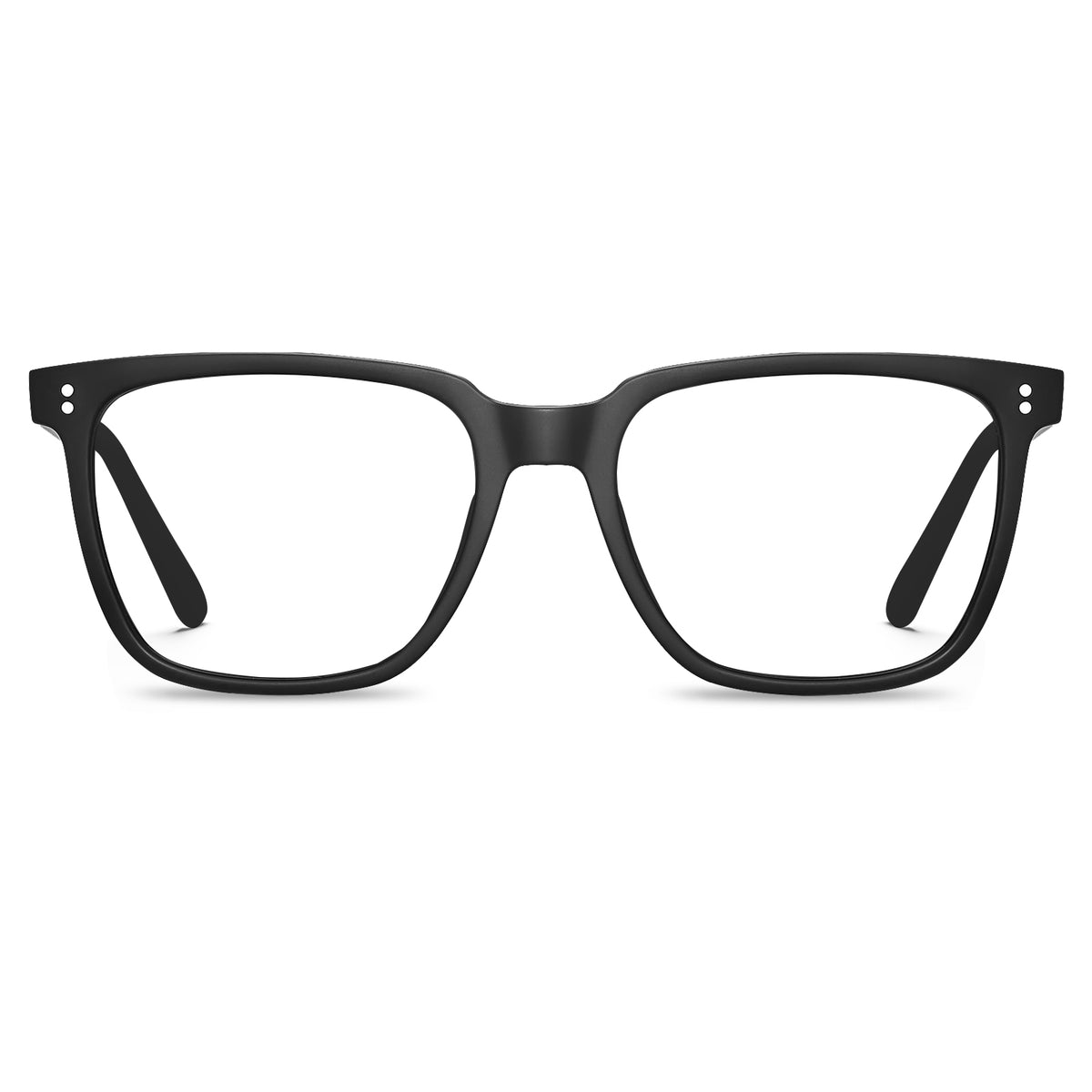
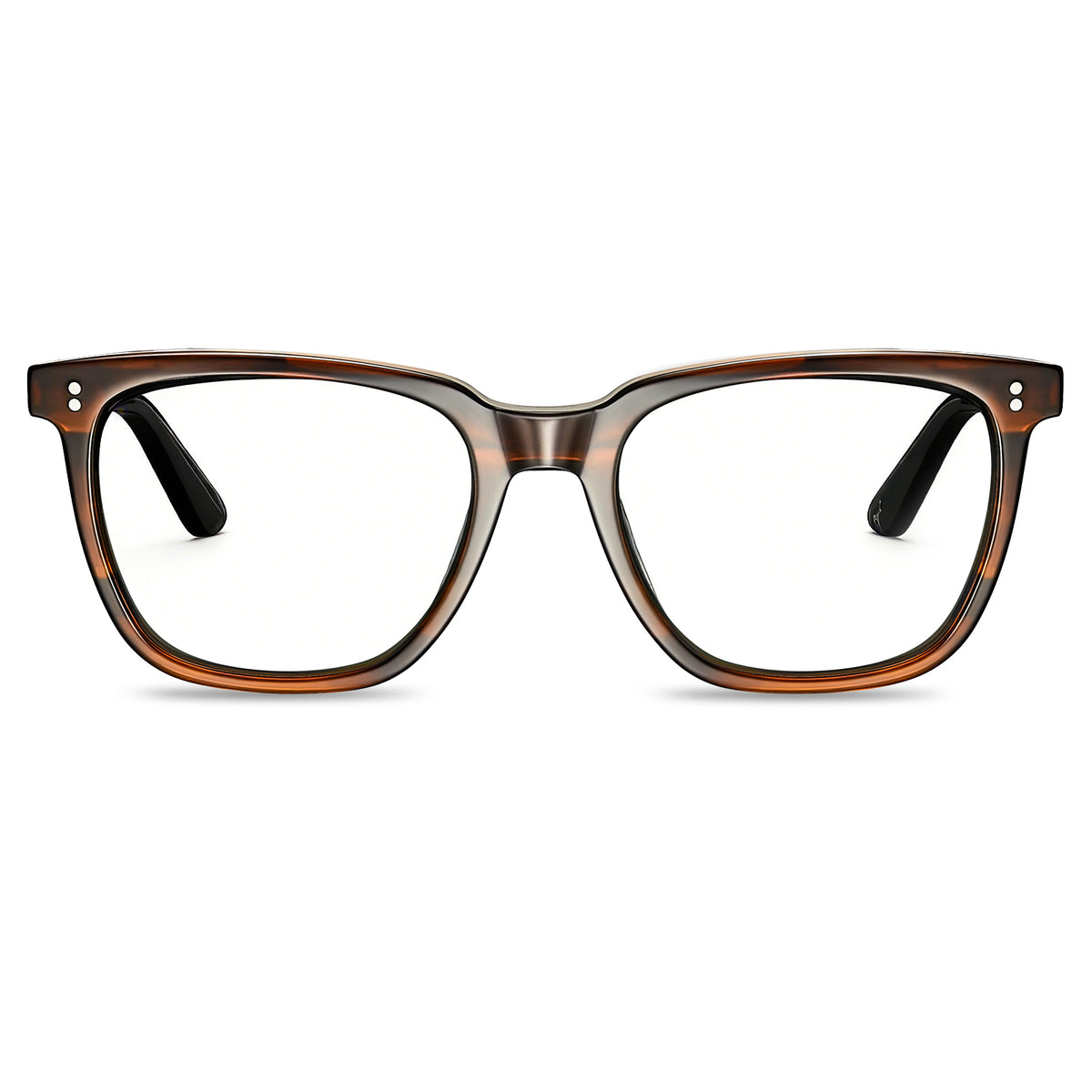
Downey-L10
140 mm square · clear acetate · 30 g
|
02
Dublin-C14
142 mm round · gold corewire · 28 g
|
03
Daley-C09
58 mm lens · 140 mm metal front · 30 g
|
04
Simba-C04
New · 148 mm square · 53 mm lens
|


What each one chooses
| Frame | Front | Lens W × H | Bridge | Weight | The choice it makes |
|---|---|---|---|---|---|
| Downey-L10 | 140 mm | 50 × 43 mm | 19 mm | 30 g | Balance: middle front, middle lens, a keyhole bridge that holds position |
| Dublin-C14 | 142 mm | 50 × 43 mm | 21 mm | 28 g | Round with detail: same measurements as Downey, gold corewire in the temples |
| Daley-C09 | 140 mm | 58 × 42 mm | 16 mm | 30 g | Maximum lens, minimum frame: the widest lens here on the narrowest bridge |
| Simba-C04 | 148 mm | 53 × 43 mm | 20 mm | 30 g | Width: a front built for larger head circumferences, in blue |
The Daley is the interesting one. A 58 mm lens on a 140 mm front means very little rim and a lot of glass, with a 16 mm bridge pulling the two lenses close together. It is the pair for someone who wants the field of view and does not want the frame in it — and the pair to avoid if a narrow bridge has ever left marks.
If the pair is for driving, the lens matters as much as the shape: polarized cuts road glare, and a 42 mm lens height keeps the top of the frame out of the mirror line. The driving sunglasses page collects those frames, and polarized sunglasses sorts the whole catalogue by lens instead of by shape.
The mistake that costs the most
The expensive mistake is not buying the wrong shape. It is buying the largest lens you can find because the lens looks impressive in a photograph, then discovering that 58 mm of glass on a narrow front puts the rim inside your field of view rather than outside it. Large lenses work when the front is wide enough to carry them; the Daley does it at 140 mm only because the bridge is 16 mm, which pulls both lenses in toward the nose.
The opposite mistake is buying the smallest frame for the same reason in reverse. A 44 mm lens is light and leaves the face open, but it also leaves the area above the cheekbone uncovered, which is exactly where low winter light comes in. If you only own one pair, the middle of the range — 49 to 53 mm of lens on a 140 to 142 mm front — is the choice that is rarely wrong. the round frame guide works through that middle range shape by shape, and frames by face shape does the same from the face side.
Buying one pair inside the window
- Measure the pair you wear most. Write down front width, lens width and bridge before you open a product page.
- Decide lens type second. Polarized for road and water, tinted for city, and the lens page if you are choosing between coatings.
- Order early in December if it is a gift. Processing 1–7 business days, shipping 5–20 — a pair ordered on 27 November has room; a pair ordered on 20 December does not.
One pair bought on measurement beats three bought on photographs.
If none of these is the one
The round sunglasses collection covers the Dublin shape in other finishes, rectangle sunglasses holds the flat-profile frames, and the women's sunglasses page groups the narrower fronts. The full range is under all sunglasses; for the winter-light version of this decision, the polarized driving guide goes deeper on lens behaviour.