







| Veterans Day · Prescription Glasses |
| Veterans Day · Wednesday 11 November 2026 · ahead of the Black Friday window |
A frame that is comfortable for an hour is not the same frame that is comfortable for twelve. The difference is rarely the shape and almost never the colour — it is how 20 to 28 grams is distributed across three contact points, and whether each of those points was chosen for your face or for the average one.
Veterans Day is Wednesday 11 November, and the pairs below are the ones people ask about when they wear glasses from a first coffee to a last light. All seven are prescription frames, five of them current best-sellers and two newer listings, and every number comes from the frame's own product page rather than a shared chart.
The article is organised around the three places a frame touches you, because that is the order in which a long day turns uncomfortable: the nose first, the ears second, the sides of the head third.
Three contact points, three numbers
- Nose wings — set by the bridge. A 17 mm bridge on a 19 mm nose concentrates pressure on a small area; a 22 mm bridge on the same nose spreads it. Every frame here runs 18 mm to 22 mm at the bridge.
- Behind the ear — set by temple length. 140 mm and 145 mm both appear below. A temple that is 5 mm short presses the ear; 5 mm long lifts the back of the frame.
- Sides of the head — set by front width. 138 mm to 145 mm here. Too narrow and the temples splay outward against the skull; too wide and the frame slides forward until the bridge takes the load.
|
01
20 g
Lightest frame here — Vinyl-FC01
|
02
28 g
The weight four of the seven share
|
03
44 mm
Deepest lens — Concord-FL10
|
04
140 mm
Shortest temple — Matthew-FC05
|
|
4–10 Nov
Before the day
Read, measure, shortlist. A front width does not change on a calendar date.
|
Wed 11 Nov
Veterans Day
Orders placed now clear processing before the holiday queue builds.
|
12–26 Nov
The quiet stretch
Two normal weeks — the safest window for anything made to order.
|
27–30 Nov
Black Friday
The same frames, a busier bench, and 1–7 business days before shipping starts.
|
Light frames, and what lightness does not solve
Weight is the first thing people look for and the last thing that decides comfort. A 20 g frame on the wrong bridge is less comfortable at hour eight than a 28 g frame on the right one, because pressure is weight divided by contact area, and a narrow bridge shrinks the area.
Vinyl-FC01 — 20 g, 138 mm, 21 mm bridge
138 mm front, 49 mm lens, 41 mm depth, 21 mm bridge, 145 mm temples, 20 g in tortoise acetate. It is the lightest frame in this article by 3 g, and the 21 mm bridge is why the low weight actually translates into comfort: the load is spread across a wider strip of nose than a 17 mm bridge allows.
Where it stops working is a wide head. At 138 mm the frame ends before the temples do, so on a broad face the arms splay and press behind the ears — the exact place a long day makes itself known. If your current pair leaves marks at the temples rather than the nose, a 138 mm front is the wrong direction.
Matthew-FC05 — 23 g with 140 mm temples
142 mm front, 55 mm lens, 40 mm depth, 17 mm bridge, 140 mm temples, 23 g. Two things stand out for a long day: the widest lens here at 55 mm, which puts the optical centre further from the rim, and the shortest temple at 140 mm, which is the number to check if your ears sit forward.
The 17 mm bridge is the constraint. On a nose that measures 19 mm, a 17 mm bridge perches rather than settles, and by the afternoon the frame has migrated down. It is a good frame for a narrow bridge and a poor one for a broad nose, regardless of the weight.
The 28 g middle, where most faces land
Four of the seven sit at 28 g, which is not a coincidence: it is the weight at which acetate can be thick enough to hold a hinge and thin enough to disappear.
Kenosha-FL12 — clear square, 142/52/19
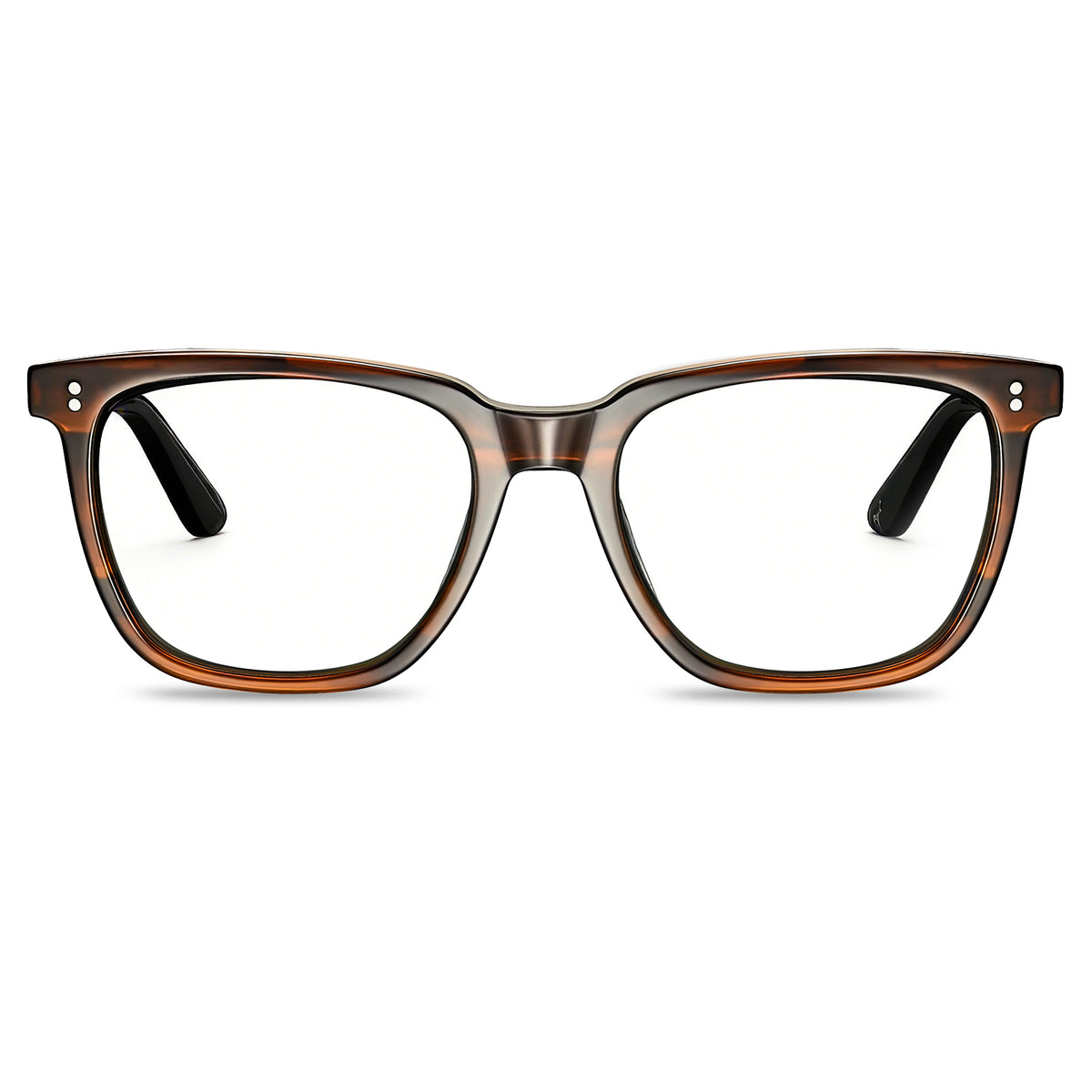
142 mm front, 52 mm lens, 41 mm depth, 19 mm bridge, 145 mm temples, 28 g. The 19 mm bridge is the middle of the range and the reason this front fits more faces than any other in the group; the clear acetate also makes the frame visually lighter, which matters at hour ten when you catch sight of yourself.
Its weakness is contrast. Clear acetate shows hinge screws and any dust that collects around them, so a frame that is comfortable all day still needs wiping more often than a dark one. That is a maintenance point, not a fit point.
Concord-FL10 — 44 mm of lens and a 22 mm bridge
142 mm front, 50 mm lens, 44 mm depth, 22 mm bridge, 145 mm temples, 28 g. The deepest lens in this article, and the one to look at if you also wear a progressive — depth is the resource that lens type spends. The 22 mm bridge makes it the most forgiving of the four 28 g frames on a broader nose.
The cost is side rim: 50 mm of lens inside a 142 mm front leaves more acetate at the edges, and on a narrow face that rim can feel present in peripheral vision. It is the trade for depth, not a fault.
Shellton-FC16 — the square that hides its weight
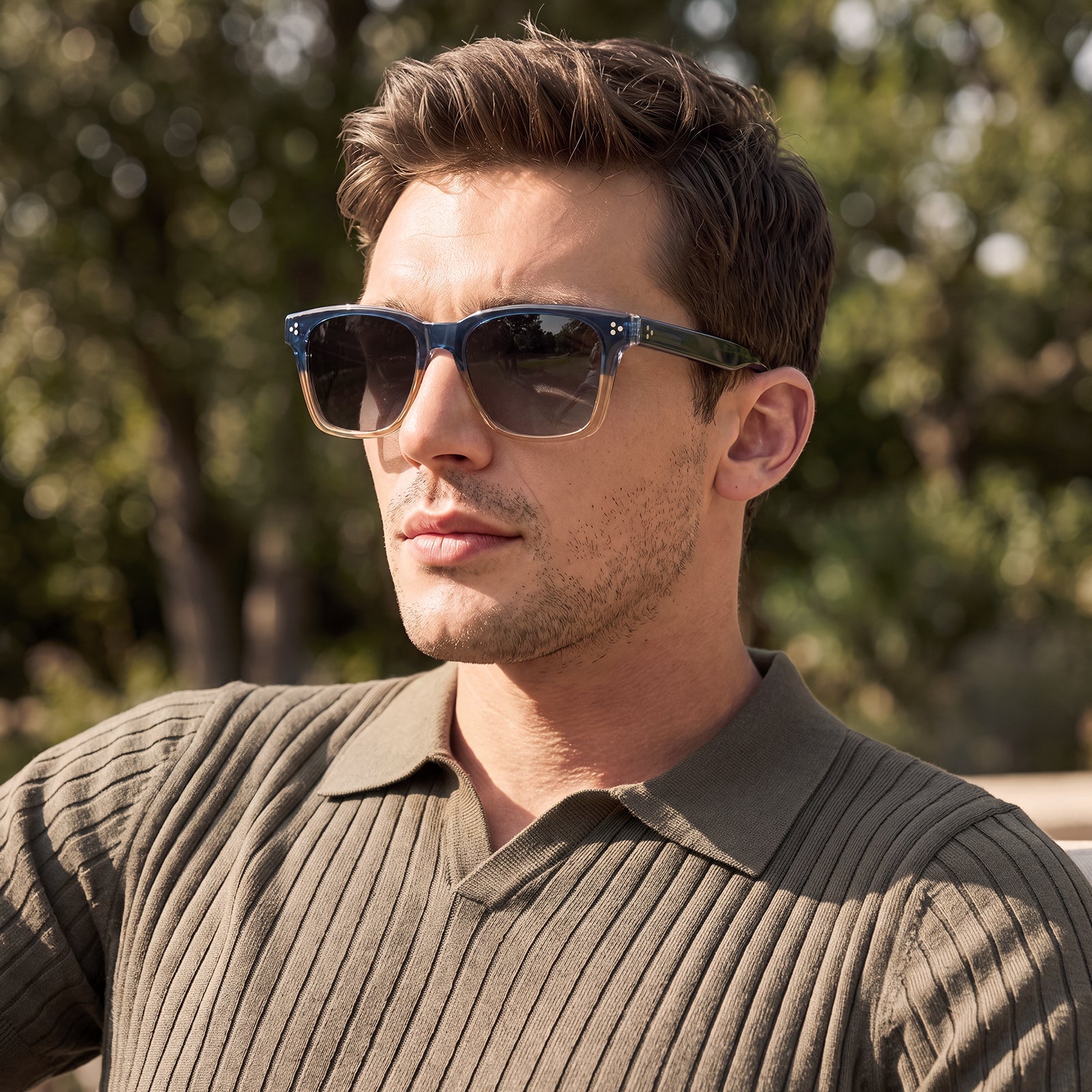
142 mm front, 54 mm lens, 41 mm depth, 18 mm bridge, 145 mm temples, 28 g, in translucent blue acetate with silver rivets. A 54 mm lens is the widest inside a 142 mm front in this article, which means less rim at each side and a frame that reads lighter than its 28 g.
Its limitation is the 18 mm bridge. It sits between the 17 mm Matthew and the 19 mm Kenosha, and on a nose that has always needed 21 mm or more it will creep down through the day. Worth measuring before you commit.
Downey-FL11 — 25 g and 140 mm of front
140 mm front, 50 mm lens, 43 mm depth, 19 mm bridge, 145 mm temples, 25 g in green acetate. It sits between the 20 g Vinyl and the 28 g group: 5 g lighter than the Kenosha on the same 19 mm bridge, and 2 mm narrower in front, which is the difference between a frame that fits and one that is slightly wide on a medium face.
Where it fails is a broad face. At 140 mm the front ends early and the temples take the load, which on a long day shows up as pressure behind the ears rather than on the nose.
The newer listing: Milo-FC01
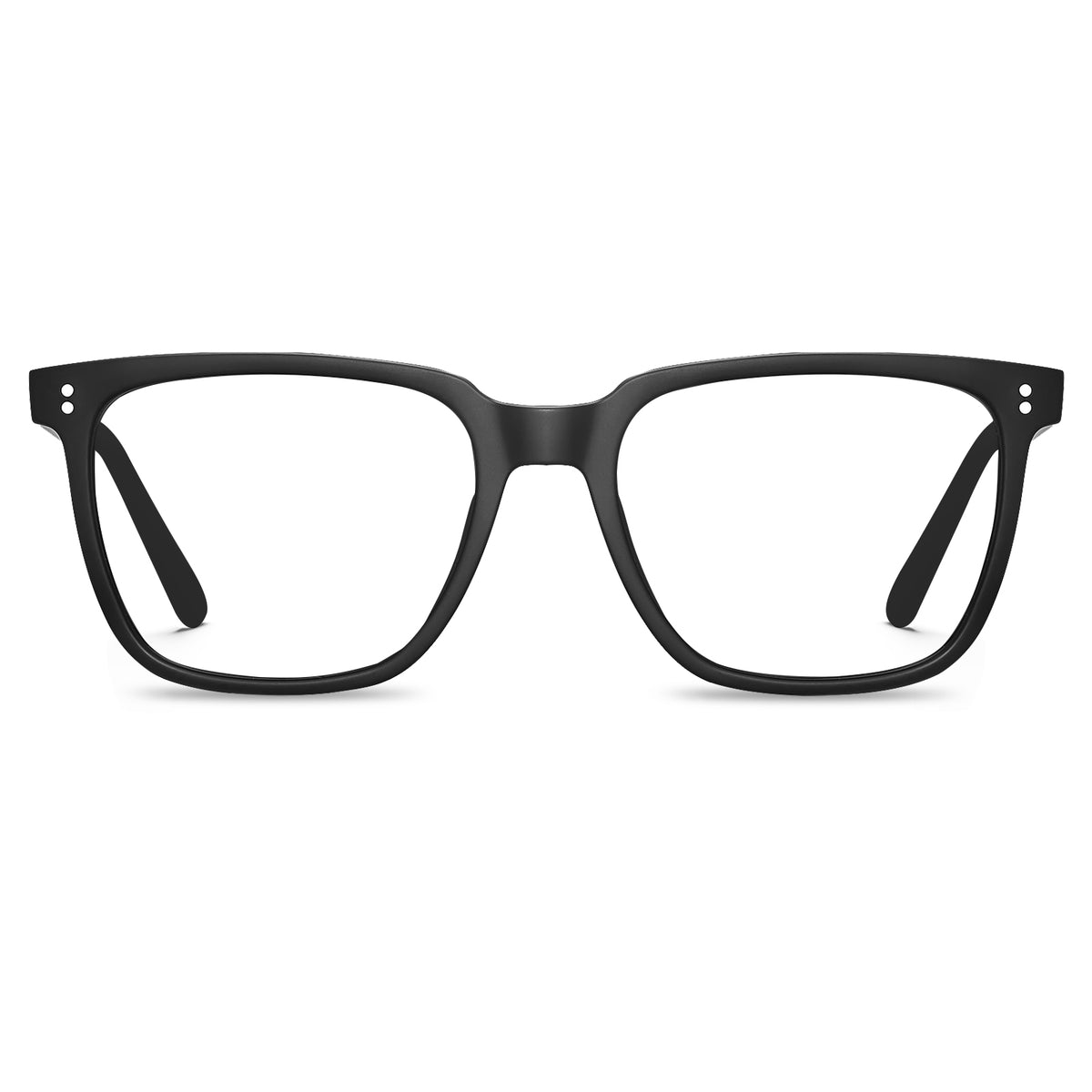
142 mm front, 48 mm lens, 42 mm depth, 22 mm bridge, 145 mm temples, 28 g in black acetate. It is the newest front in the group and the narrowest lens at 48 mm, which gives it the most rim per millimetre of front — visually the most substantial pair here, and the most forgiving if you want a frame that stays where it is put on a broad nose.
The trade is field of view: 48 mm of lens inside 142 mm means you look through a smaller window with more frame around it. For desk work that is invisible; for anything where you rely on peripheral vision, it is a factor.


Seven frames, one table
| Frame | Shape | Front | Lens W × H | Bridge | Weight | Best for |
|---|---|---|---|---|---|---|
| Matthew-FC05 | Rectangle | 142 mm | 55 × 40 mm | 17 mm | 23 g | A narrow bridge and forward-set ears |
| Shellton-FC16 | Square | 142 mm | 54 × 41 mm | 18 mm | 28 g | A 54 mm lens on a standard front |
| Kenosha-FL12 | Square | 142 mm | 52 × 41 mm | 19 mm | 28 g | The average face, in clear acetate |
| Concord-FL10 | Round | 142 mm | 50 × 44 mm | 22 mm | 28 g | Depth, and a broader nose |
| Downey-FL11 | Square | 140 mm | 50 × 43 mm | 19 mm | 25 g | A medium face at lower weight |
| Milo-FC01 (new) | Square | 142 mm | 48 × 42 mm | 22 mm | 28 g | More rim, more forgiveness |
| Vinyl-FC01 (new) | Round | 138 mm | 49 × 41 mm | 21 mm | 20 g | A narrow face and low weight |
Measurements are the Frame Size block on each product page — frame width, bridge, lens width, lens height, temple length — with weight as published in the frame's own specification. They are cross-checked against the frame-width field in the back office. Nothing here is a medical claim: comfort over a long day is a fit question, and the failure conditions described above are arithmetic, not diagnosis. If a frame leaves a mark that does not fade within an hour of removing it, that is a reason to change the bridge or the temple, not to push through.
A three-minute check before you order
- Measure the bridge of the pair you can wear all day. That number, not the front width, is what keeps a long day comfortable.
- Check the temple against your ear. If a 145 mm arm leaves a mark, look at the 140 mm frame rather than a wider front.
- If you have strong astigmatism or a high prescription, read high-index lenses for strong prescriptions before choosing the front — lens thickness changes which rim hides it.
The lightest frames in this article are collected under lightweight eyeglasses, the hand-polished acetate fronts under acetate eyeglasses, and the two shapes with the most room at the brow are under square eyeglasses and round eyeglasses. For everything else in this range, all eyeglasses is the full list.
On the pressure side of the same question, nose marks and bridge fit explains what a mark under the pad actually means, and the frame measurement guide shows where to put the ruler.
Comfort is not a lighter frame. It is the same weight spread over the right places.