








| Veterans Day · Sunglasses |
| Veterans Day · Wednesday 11 November 2026 · ahead of the Black Friday window |
Most sunglasses articles are written for a photograph. This one is written for the fourth year of ownership — the point at which a pair has either become the thing you reach for without thinking, or has been quietly retired to a drawer with a loose hinge.
Veterans Day is Wednesday 11 November. The window matters less than the order of decisions: a frame is bought once and used for years, so the numbers that decide whether it survives are not the ones printed on a campaign banner. They are the four measurements below, and every frame in this article has them taken from its own product page rather than from a shared size chart.
Seven pairs follow: five current best-sellers from the range and two newer fronts. All are polarized, all are in stock, and all are described with the failure each number predicts — because a specification that only lists benefits is a specification you cannot check.
Four things break before the frame does
- The hinge. A five-barrel hinge spreads load across more contact points than a three-barrel one, which is why spring hinges matter on a frame you take off one-handed. On the pairs below, spring hinges appear where the product text names them — no further.
- The temple core. Acetate arms carry a wire core; metal arms are the core. A 145 mm temple on a 142 mm front leaves 3 mm of wrap, and that is what keeps the frame from migrating forward when you look down.
- The lens stack. Polarized lenses are laminated, and the layer count is where glare filtering happens. Nine-layer stacks are quoted on the Shelton block; a single-layer tint is not the same product.
- The weight. 25 g to 30 g is the whole spread here. Below 20 g a frame starts to feel insubstantial on a broad nose; above 30 g it becomes a thing you notice at hour six.
|
01
142 mm
Front width on four of the seven
|
02
148 mm
The widest front here — Simba-C02
|
03
16 mm
Narrowest bridge, on the Daley pairs
|
04
25 g
Lightest frame in the group
|
|
4–10 Nov
Before the day
Read, measure, shortlist. A front width does not change on a calendar date.
|
Wed 11 Nov
Veterans Day
Orders placed now clear processing before the holiday queue builds.
|
12–26 Nov
The quiet stretch
Two normal weeks — the safest window for anything made to order.
|
27–30 Nov
Black Friday
The same frames, a busier bench, and 1–7 business days before shipping starts.
|
Why this article leads with construction
Sunglasses fail in a specific order. First the hinge loosens, then the temple tips stop gripping, then the lens coating picks up a haze along the top edge where it meets the brow. None of those failures show up in a product photograph, and none of them are solved by buying the same silhouette again in a different colour.
What you can check before ordering is the arithmetic of the frame: front width against your own, bridge against the pair that never slides, temple length against the distance from hinge to ear. The rest — acetate block, lens stack, rivet reinforcement — tells you how long the arithmetic will keep working.
The five current pairs
These are the frames that carry the range on volume. Each one is described below by the number that decides its job, not by the colour story.


Shelton-C18 — the 142 mm square that takes the most abuse
142 mm front, 54 mm lens, 40 mm depth, 18 mm bridge, 30 g. The volume here is in the rim: a 54 mm lens inside 142 mm of frame leaves very little air at the corners, which is what makes the front feel solid rather than decorative. The lens is a nine-layer polarized stack quoted at 100% of UVA and UVB.
Where it stops working is a narrow face. A 142 mm front with a 54 mm lens keeps its width all the way down, so on a face that tapers sharply the lower corners sit past the cheekbone. If that describes you, the small-fit pairs further down are the correction rather than a compromise.
Daley-C07 — metal, 58 mm of lens, 16 mm of bridge
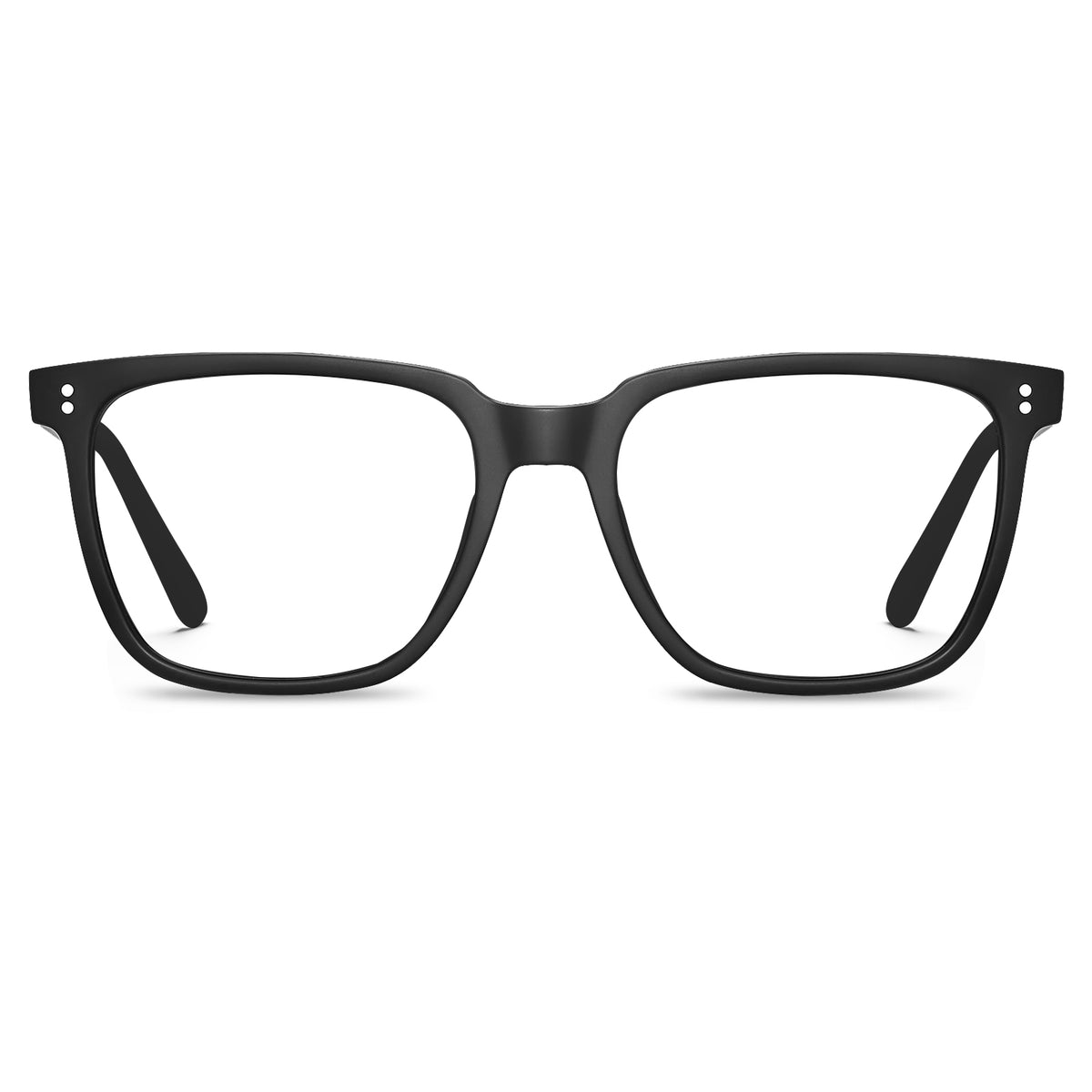
The Daley is the outlier of the group: a metal rectangle at 140 mm with a 58 mm lens and a 42 mm depth, on a 16 mm bridge and 140 mm temples, at 28 g. Five of the seven frames here sit at 18 mm or wider; 16 mm is the narrowest bridge in the article, and it is the number to check first if a frame has ever slid down your nose.
One honest note on this range: the product description still calls the lens 'square-shaped', while the shape field and the Shape line on the product page both say Rectangle. The measurements and the front view agree with Rectangle, so that is what this article uses — but if the exact silhouette matters to you, look at the front photograph rather than the sentence.
Concord-L11 — the deepest lens before the Aviator
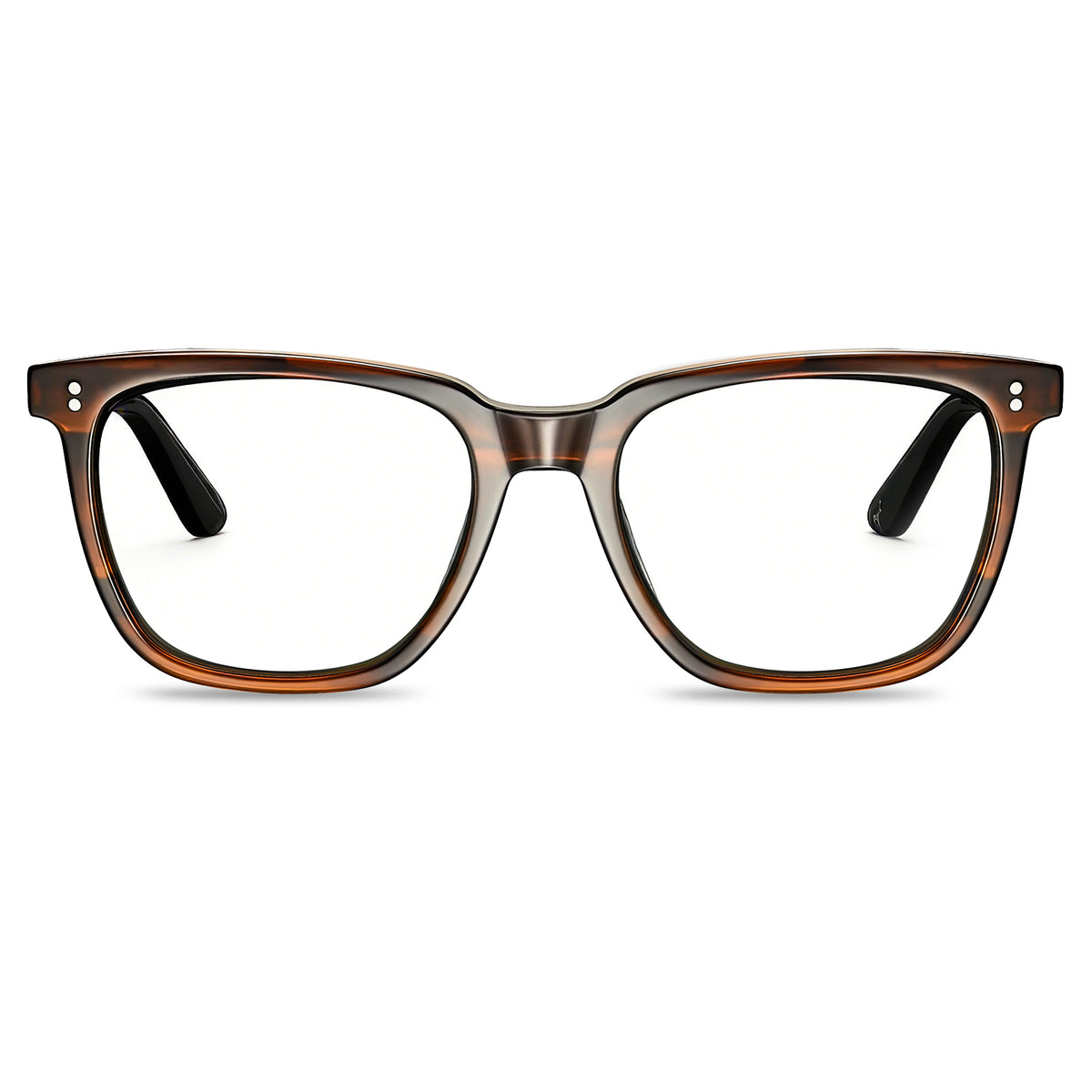
142 mm front, 50 mm lens, 44 mm depth, 22 mm bridge, 30 g in tortoise acetate. The 44 mm depth is the second-deepest lens in this article and the reason the Concord keeps light out of the top of the eye without a wide brow bar. The lens is quoted at UV400 across UVA, UVB and UVC, with filtering to 400 nm.
The trade is width of view. A 50 mm lens on a 142 mm front leaves a visible rim at the edges of peripheral vision; on a first pair of round sunglasses that reads as a frame in the way, not as a fault. Most people stop noticing inside a week.
Peoria-C1 — 147 mm, 49 mm deep, and 25 g
The Peoria is the only TR frame here: 147 mm front, 53 mm lens, 49 mm lens height, 19 mm bridge, 148 mm temples, 25 g. TR is the reason a 147 mm front can weigh less than the 142 mm acetate squares beside it, and 49 mm of lens height is the most brow coverage on the page.
The limitation is on the other side of the same property. A TR front flexes, so it forgives a wide head and does less to hold its own shape on a narrow one; and a 147 mm front on a face under about 138 mm of temple-to-temple width will sit wide. It is the one frame here that should be measured rather than guessed.
Kenora-C04 — the small-fit square
138 mm front, 51 mm lens, 40 mm depth, 17 mm bridge, 145 mm temples, 30 g, in hand-polished plant-based acetate. On a page of 142 mm fronts this is the pair that fits the people the others leave out, and the 17 mm bridge is what keeps a smaller front from sitting low.
Where it fails is the opposite face: at 138 mm the frame ends before a wide temple does, so on a broad head the temples press outward and the front lifts. If your current pair leaves marks behind the ears rather than on the nose, this is not the frame for you.
The two newer fronts
Both arrived in the last year and both are wider than the group average, which is the direction the range has been moving.
Simba-C02 is a 148 mm square on a thick acetate block: 53 mm lens, 43 mm depth, 20 mm bridge, 148 mm temples, 30 g, with electroplated gradient rivets at the corners. The block thickness is the point — a 148 mm front in a thin acetate bows at the bridge, and this one does not. Navada-C02 is a 142 mm square at 55 mm of lens and 45 mm of depth, 17 mm bridge, 30 g in gold, which puts it between the Concord's depth and the Daley's width. The wider fronts are listed together under men's sunglasses, and the whole polarized range is under polarized sunglasses.
Seven frames, one table
| Frame | Shape | Front | Lens W × H | Bridge | Weight | What the number buys you |
|---|---|---|---|---|---|---|
| Shelton-C18 | Square | 142 mm | 54 × 40 mm | 18 mm | 30 g | The most lens inside a standard front |
| Daley-C07 | Rectangle | 140 mm | 58 × 42 mm | 16 mm | 28 g | The widest lens on the narrowest bridge |
| Concord-L11 | Round | 142 mm | 50 × 44 mm | 22 mm | 30 g | Depth for overhead light |
| Peoria-C1 | Square | 147 mm | 53 × 49 mm | 19 mm | 25 g | Height for brow coverage, at low weight |
| Kenora-C04 | Square | 138 mm | 51 × 40 mm | 17 mm | 30 g | A smaller front that still holds its line |
| Simba-C02 (new) | Square | 148 mm | 53 × 43 mm | 20 mm | 30 g | The widest front, on a thick block |
| Navada-C02 (new) | Square | 142 mm | 55 × 45 mm | 17 mm | 30 g | A wide lens without a wide front |
Every measurement above is the Frame Size block on that frame's own product page — front width, bridge, lens width, lens height, temple length — cross-checked against the frame-width field in the back office. Two description texts in this range are older than the shape data and still use the word 'square' generically; where the description and the shape field disagree, this article follows the shape field and the front view, and says so in the relevant section. Nothing here is a laboratory test: durability is inferred from construction, not measured in a drop rig.
What this article does not claim
It does not claim any pair is unbreakable, and it does not claim a weight below 30 g makes a frame better. Weight is a fit variable: a 25 g frame on a nose that needs pressure to hold position will slide, and a 30 g frame on a face that finds 30 g heavy will be taken off by lunchtime. The number that matters is the one that matches your own, not the smallest one on the page.
If you have never measured a pair, how to measure a frame you own covers the hinge-to-hinge measurement, and the frame measurement guide is the same method with photographs. For the material side of the question — why acetate behaves differently from TR and metal — why frame material matters is the longer read.
A pair survives because the numbers fit, not because the frame was expensive.
Ordering inside the Veterans Day window
- Measure the pair you wear most, hinge to hinge. That number decides the front width, and it is the only measurement you cannot estimate.
- Check the bridge against a frame that never slides. If 19 mm has always worked, the 16 mm Daley is the one to skip.
- Order before 11 November if the pair is a gift. Processing runs 1–7 business days and shipping 5–20, so the earlier order lands with room to spare.
If you want to keep browsing by silhouette rather than by frame, the square fronts in this article — including the 148 mm and 147 mm pairs — sit together under square sunglasses, the flat-profile frames under rectangle sunglasses, and every hand-polished acetate front under acetate sunglasses.