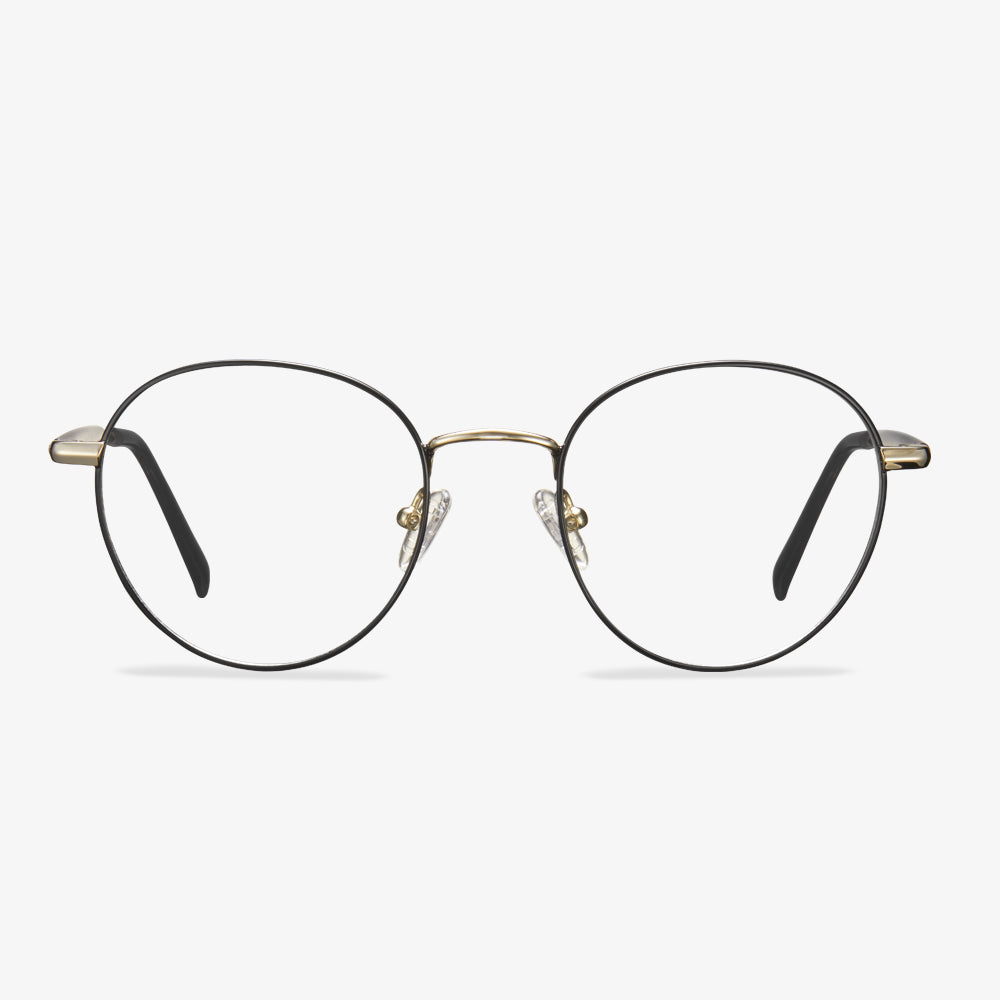










There is a rule of thumb in eyewear that sounds sensible and is only half true: bigger lenses mean a bigger field of view, so bigger is better. That holds for frame width. It stops holding the moment you put a prescription inside the lens.
Lens width is the horizontal distance of one lens, measured inside the rim at its widest point. Across our fifteen best-selling prescription frames it runs from 44 mm to 58 mm. As a pure style choice, that range is taste. As an optical decision, it is arithmetic — and the arithmetic starts with two numbers most shoppers never put together. Your PD is the other half of that sum, and how to measure your PD covers it step by step.
Two numbers you can add: frame PD
Add the lens width to the bridge width and you get the frame's pupillary distance — the distance between the two optical centres of the frame as manufactured. A frame marked 55 17 has a frame PD of 72 mm. That number is not printed on the frame, and it is the one your lens lab works from.
Your own PD is the distance between your pupils, typically somewhere between 58 and 68 mm. If the frame PD and your PD match, each lens is centred exactly where the frame puts it. If they differ, each lens has to be decentred by half the difference:
Decentration per lens = (frame PD − your PD) ÷ 2. A 55 17 frame on a 64 mm PD needs 4 mm of decentration per lens. A 58 16 frame on the same PD needs 5 mm.
Four or five millimetres sounds trivial. It is not, once the lens has to be cut from a blank large enough to contain that offset.
What decentration does to a strong minus lens
A minus lens is thinnest at its optical centre and thickest at its edge. Two things increase that edge thickness: a larger lens diameter, and a larger offset from the blank's centre. A wide frame manages to do both at once — the lens is bigger and the optical centre has to be moved further inward to sit over your pupil.
This is why a −5.00 in a 58 mm lens can be visibly thicker and noticeably heavier than the same prescription in a 44 mm lens, even in the same lens material. And why the honest advice for a strong prescription is not “buy a smaller frame”, but “know what the width costs you before you choose it”. If you already know you need a high index, the high-index advantage explains what changes and what does not.
- Low prescription (roughly under ±2.00): lens width is almost purely a style decision. The edges stay thin in anything.
- Moderate (±2.00 to ±4.00): width starts to matter. Wide lenses in a thick acetate rim still look fine; wide lenses in a thin metal rim start to show.
- Strong (±4.00 and above): lens width becomes the single biggest lever you control. Narrower lens, higher index, and a rim with some depth to it.
Why the rim matters as much as the width
A 58 mm lens in a thick acetate rectangle hides its edge inside the rim. The same lens in a thin metal frame exposes it, because there is nothing to hide behind. This is the part that trips people up: they choose a narrow metal frame to “look minimal”, at a strong prescription, and then wonder why the glasses look heavy. Metal frames are the extreme case, which is why our metal eyeglasses read very differently at the same lens width.
Rim and width work as a pair. Wide lens plus thick rim is a style statement with an optical cost hidden inside it. Narrow lens plus thin rim is the lightest possible result. Wide lens plus thin rim is the one combination that shows everything.
The width range across five frames
| Model | Lens width | Frame PD (lens + bridge) | What it means in practice |
|---|---|---|---|
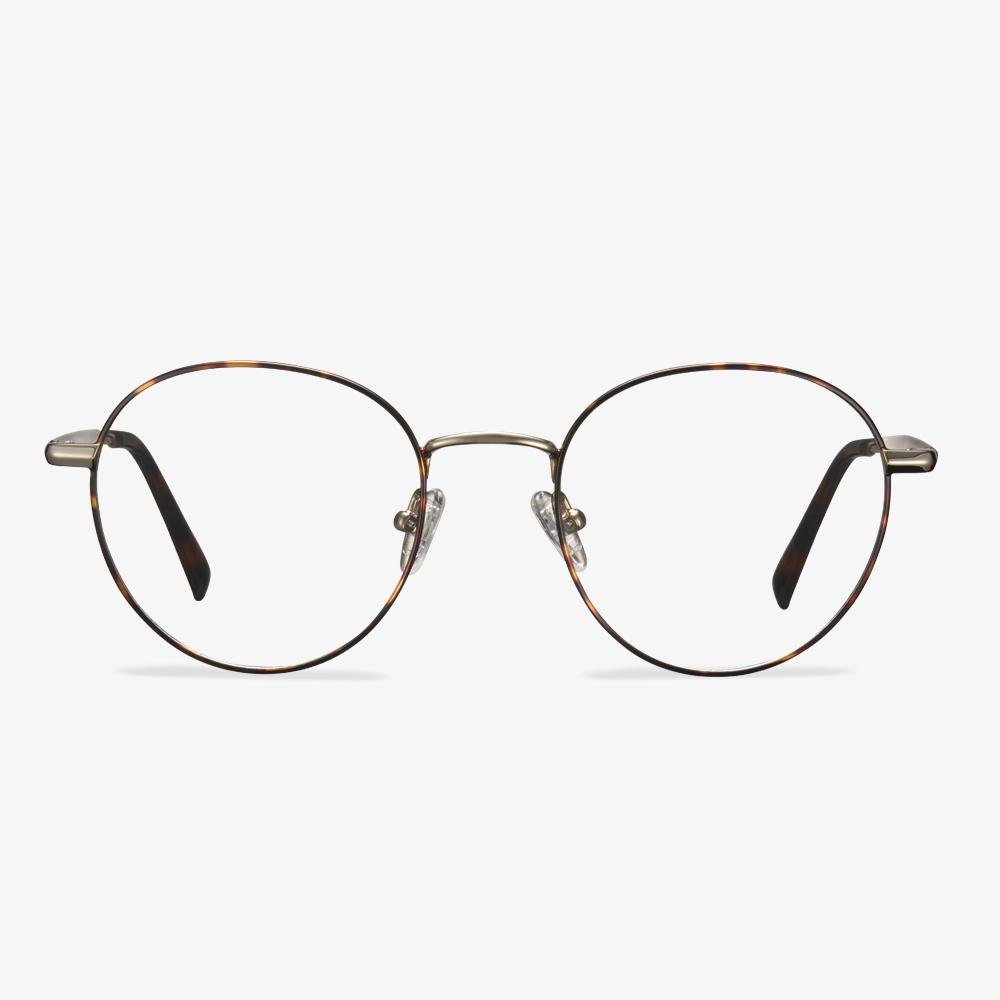
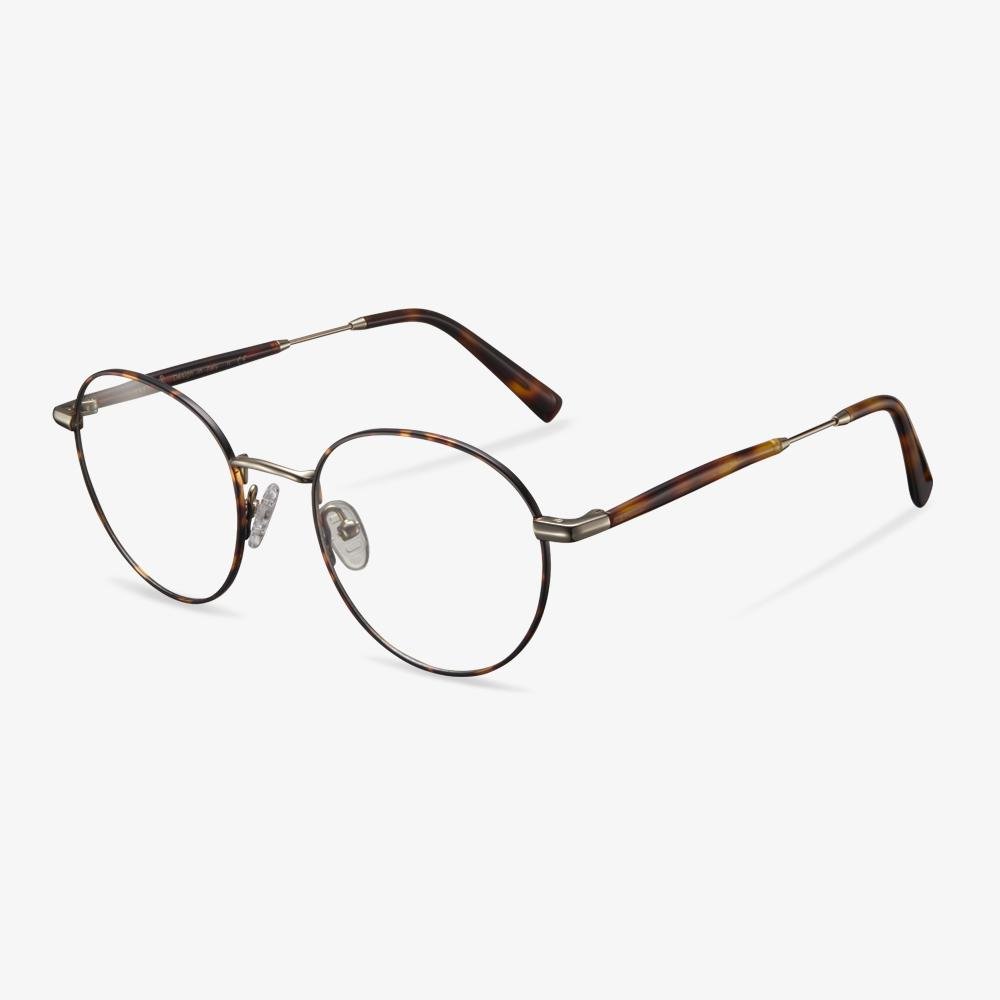
| Baley-FC07 | 58 mm | 74 mm | The widest lens we sell in volume, in a metal rim — best kept for low prescriptions |
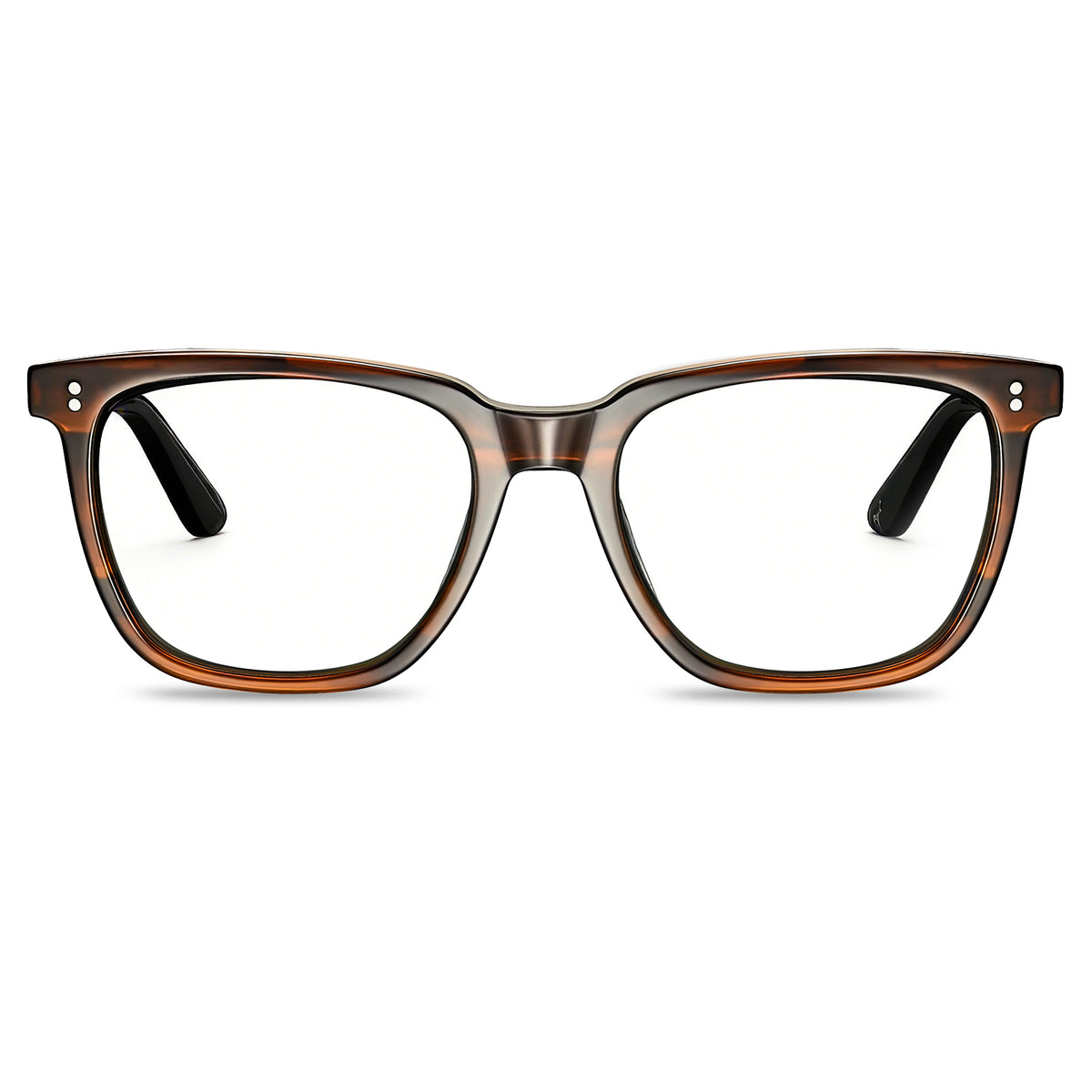
| Mathew-FC06 | 55 mm | 72 mm | Wide and shallow; needs 4 mm of decentration on a 64 mm PD |
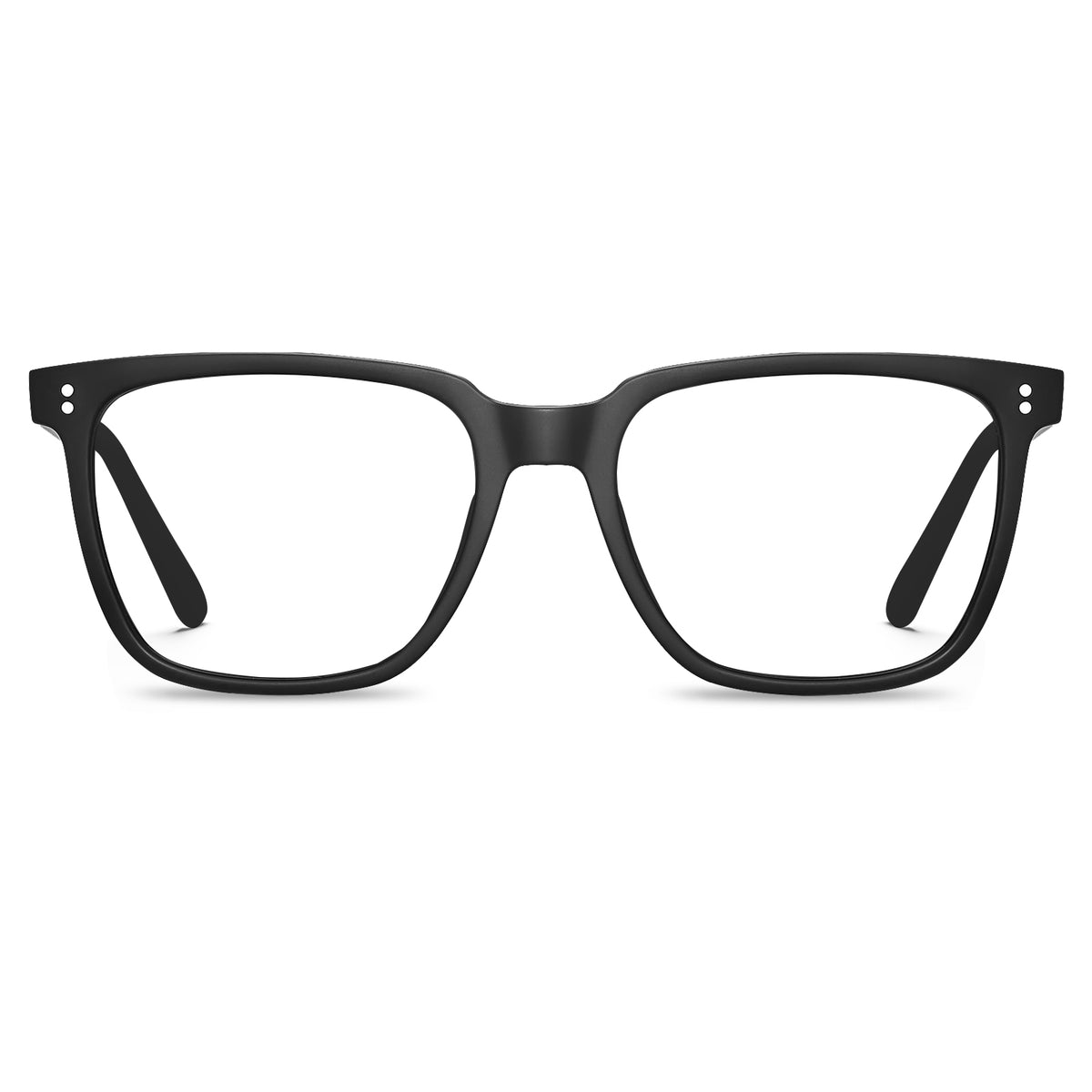
| Shellton-FC01 | 54 mm | 72 mm | Wide, but the acetate rim gives the edge somewhere to sit |
| Mesa-FC03 | 48 mm | 70 mm | Mid-width, round; the least demanding of the five optically |
| Retroz-FC01 | 44 mm | 72 mm | The narrowest lens here, paired with the widest bridge — a small lens over a broad nose |
Read the third column rather than the second. A narrow lens on a wide bridge and a wide lens on a narrow bridge can land on the same frame PD — and the frame PD, not the lens width, is what your lens has to be cut around. The optical side — index, coatings, treatments — is set out on our lenses page.
Five frames, five different optical profiles

58 mm lens, 16 mm bridge, metal rim. The most open view in the range and the least forgiving of a strong prescription: a metal rim gives lens edge nowhere to hide.
Frame width 141 mm · Lens 58 × 45 mm · Bridge 16 mm

55 mm lens in a transparent grey acetate, best described as oversized. Wide enough to need real decentration, shallow enough at 40 mm that it stays closer to square than to round.
Frame width 142 mm · Lens 55 × 40 mm · Bridge 17 mm

54 mm lens in a 54 mm-deep rectangle, inside a substantial acetate rim — the combination that keeps a strong minus lens looking tidy, because the acetate covers the edge instead of exposing it.
Frame width 142 mm · Lens 54 × 41 mm · Bridge 18 mm

48 mm lens and 22 mm bridge: the closest to a neutral optical profile in this list, and the easiest of the five to fit at any prescription.
Frame width 138 mm · Lens 48 × 43 mm · Bridge 22 mm

44 mm lens on a 28 mm bridge — the narrowest lens in the top fifteen. If your PD is narrow, or your prescription is strong, this is the geometry that asks the least of the lens.
Frame width 140 mm · Lens 44 × 43 mm · Bridge 28 mm
The high-index question, briefly
Lens width and lens index solve the same problem from different directions. A higher index material makes a thinner lens for a given prescription; a smaller lens makes a thinner lens for a given material. Doing both is how a strong prescription stays wearable, and doing neither is how people end up with glasses they describe as “heavy” when what they mean is thick at the edge.
The practical order is: establish your prescription and PD, choose a lens width that does not fight them, then decide whether the index upgrade is worth it for the frame you have chosen. Choosing the frame first and asking about index afterwards is the order that produces disappointments. If you would rather start from the frames and work backwards, the eyeglasses collection lists every width in one place.
The same arithmetic for a plus prescription
A plus lens is the mirror image: thinnest at the edge, thickest at the centre, where the material has to bow out to do its work. A larger lens increases that bow — the sag of the curve — so a wide lens in a plus prescription gets thicker at the centre as well as heavier overall. The instinct that a bigger lens spreads the thickness out is wrong in both directions.
What changes is which part of the lens you notice. In a minus prescription the edge is the problem, and the rim can cover it. In a plus prescription the centre is the problem, and no rim helps at all — which is why a plus prescription in a very large frame tends to look thicker in the middle than the numbers suggest.
What a narrow lens does to the look of the frame
There is a style consequence here that is usually discovered by accident. A narrow lens in a wide front — 44 mm of lens on a 140 mm frame — leaves room for a substantial bridge and longer end pieces, and the result reads as a smaller, more deliberate pair of glasses. A wide lens in the same width reads as an open front with very little frame around it: more view, less border. If your face is narrow, the frames grouped under eyewear for small faces are chosen on exactly this geometry.
Neither is the correct answer. The point is that lens width is doing two jobs at once — optics and proportion — and it is the only measurement in eyewear that changes both at the same time. Square frames make the trade most visible, because the corners show edge thickness first, and the square eyeglasses range is where to compare.
What to check before you order a wide frame
- Your PD — from a recent prescription, or measured at home; it is the one number that turns lens width into arithmetic.
- Your face width at the temples. Frame width should be within a couple of millimetres of it; a 58 mm lens usually means a frame over 140 mm.
- Your prescription, in sphere. Above ±4.00, read lens width as a constraint rather than a preference.
- The rim. Thin metal and wide lens is the combination that shows edge thickness most clearly.
The single most useful sentence here: a wide lens does not make your vision wider in any way you will notice, but it does make the lens thicker at the edge in a way you will feel. Field of view comes from frame width and lens height far more than from lens width alone.
The short version
- Lens width plus bridge equals frame PD. That is the number your lens lab uses.
- Half the difference between frame PD and your PD is how far each lens has to be decentred.
- More decentration and a bigger lens both add edge thickness in a minus lens.
- A thick rim hides that. A thin rim does not.
- If your prescription is strong, choose the lens width first and the frame style second — not the other way round.