









Almost every frame page says “premium acetate” and then moves straight to colour names. That phrase is doing a lot of hidden work. The material decides how deep the rim can be cut, how much of a lens edge it can hide, whether the pattern will still be there in year three, how much the frame weighs, and whether an optician can move the fit two millimetres without cracking anything.
This guide takes the claim apart and puts it back together on five Carfia optical frames that sell in volume rather than on a spec sheet: a 142 mm square, a 140 mm retro square cut from imported Italian acetate fibre, a 140 mm round with a 28 mm bridge, a 141 mm square, and a 20 g rectangle. Every number below is on the product page — none of it is a general statement about “quality”.
What cellulose acetate actually is
Acetate begins as cotton linters or wood pulp. The fibre is treated with acetic acid, and what comes out is a plant-based plastic that can be transparent, translucent or opaque, and that holds colour with unusual depth. The chemistry is the boring part. The manufacturing difference is the useful part: optical acetate is delivered as solid sheets, and a frame is cut out of the sheet, then tumbled and polished until the edges go smooth and glassy.
Injection-moulded plastic works the other way around — pellets are melted and poured into a mould. That is faster and cheaper, but the colour sits differently. When a frame is cut from a block of acetate, the pattern runs through the material. It cannot flake off a temple tip the way a sprayed-on finish can, because there is no coating to flake. It also means the maker cannot hide a cheap core, which is why acetate frames tend to be judged on their edges.
We wrote the longer version of this distinction in a separate piece: handmade acetate versus plastic frames. This article stays on what the material does to the fit and the look.
Rim depth is the first thing you notice — even if you never name it
Rim depth is the vertical face of the frame front, the flat band of material that surrounds the lens. On a metal frame it is around a millimetre. On an acetate frame it is routinely four to six millimetres, because the material is strong enough in a solid block to hold a lens without a metal carrier behind it.
That depth does two jobs at once. It gives the frame its visual weight, and it covers the edge of the lens. With a moderate prescription the second job is invisible and you can choose either material freely. As the prescription climbs, the lens gets thicker at the edge, and a thin metal rim starts showing that edge from the side while a deeper acetate rim simply swallows it. If your prescription is strong and you want the frame to look quiet rather than clever, this is the whole argument for acetate in one sentence.

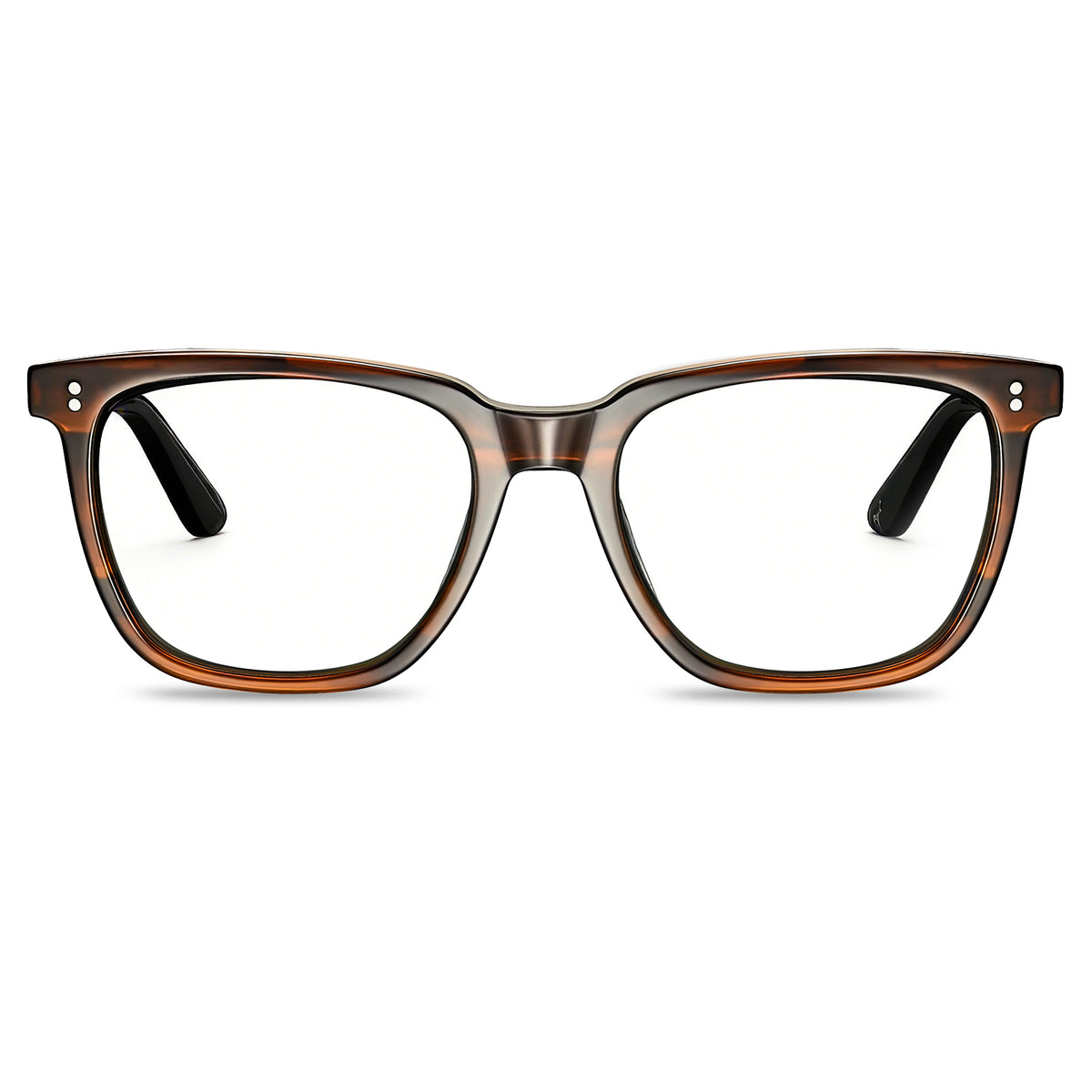
A 142 mm lamination acetate square with a 53 mm lens, 41 mm lens height and 19 mm bridge — the closest thing here to a plain optical rectangle, and the one that hides a thicker lens edge most easily.
Frame width 142 mm · Lens 52 × 41 mm · Bridge 19 mm
The Kenosha is also the clearest example of lamination: several thin sheets of acetate are pressed into one block before the frame is cut, so the colour exists in layers rather than as a surface. That is why it can be polished back and look the same.
Colour comes from inside the sheet, which changes how translucency behaves
A tortoise pattern in acetate is not printed. It is built by folding and pressing differently coloured acetate until the swirls are volumetric, which is why two frames from the same run never match exactly. Opaque black is the most forgiving option: it reads as a clean line at any distance and, for the reason above, hides lens edge thickness better than any other finish.
Translucent finishes are the opposite trade. They look lighter on the face and photograph beautifully, but they also reveal the internal structure of the frame — including, at higher prescriptions, the edge of the lens. That is not a defect; it is the material being honest. If you want translucency, and you also want a strong prescription, plan for a high-index lens so there is less edge to see.

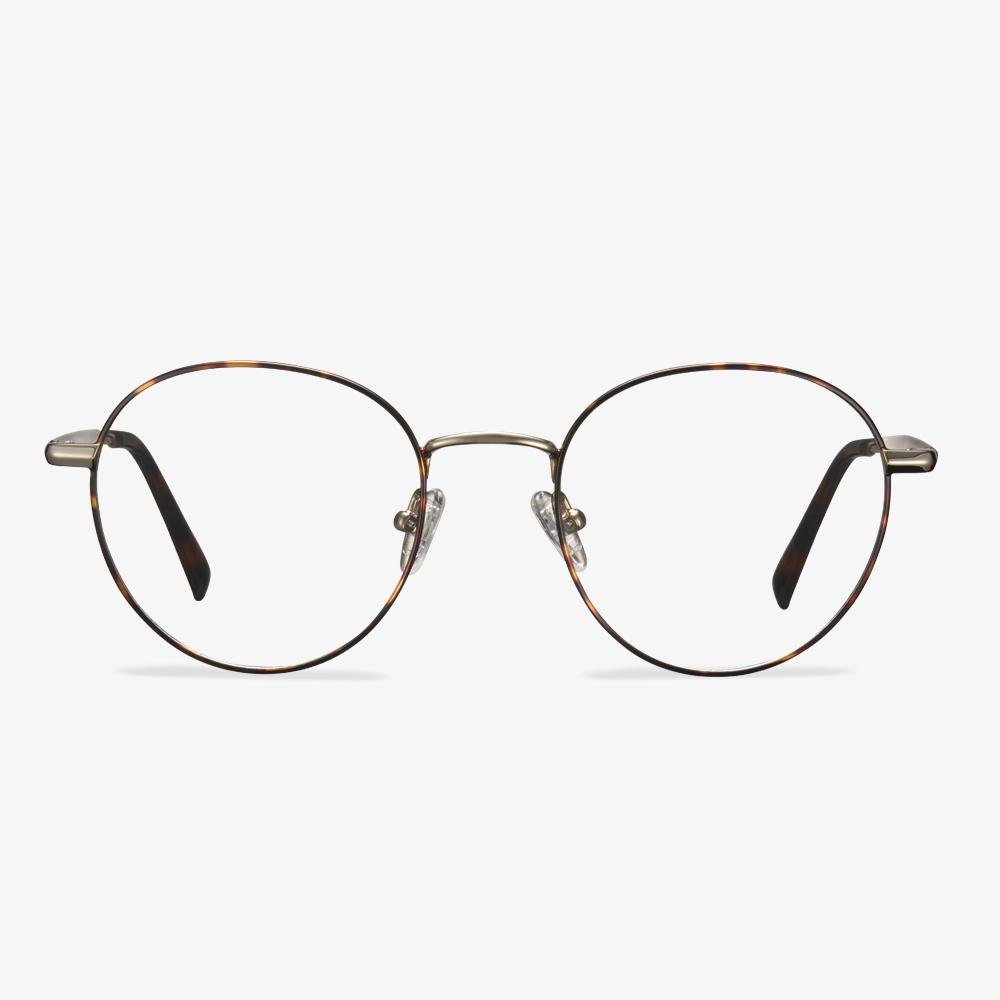
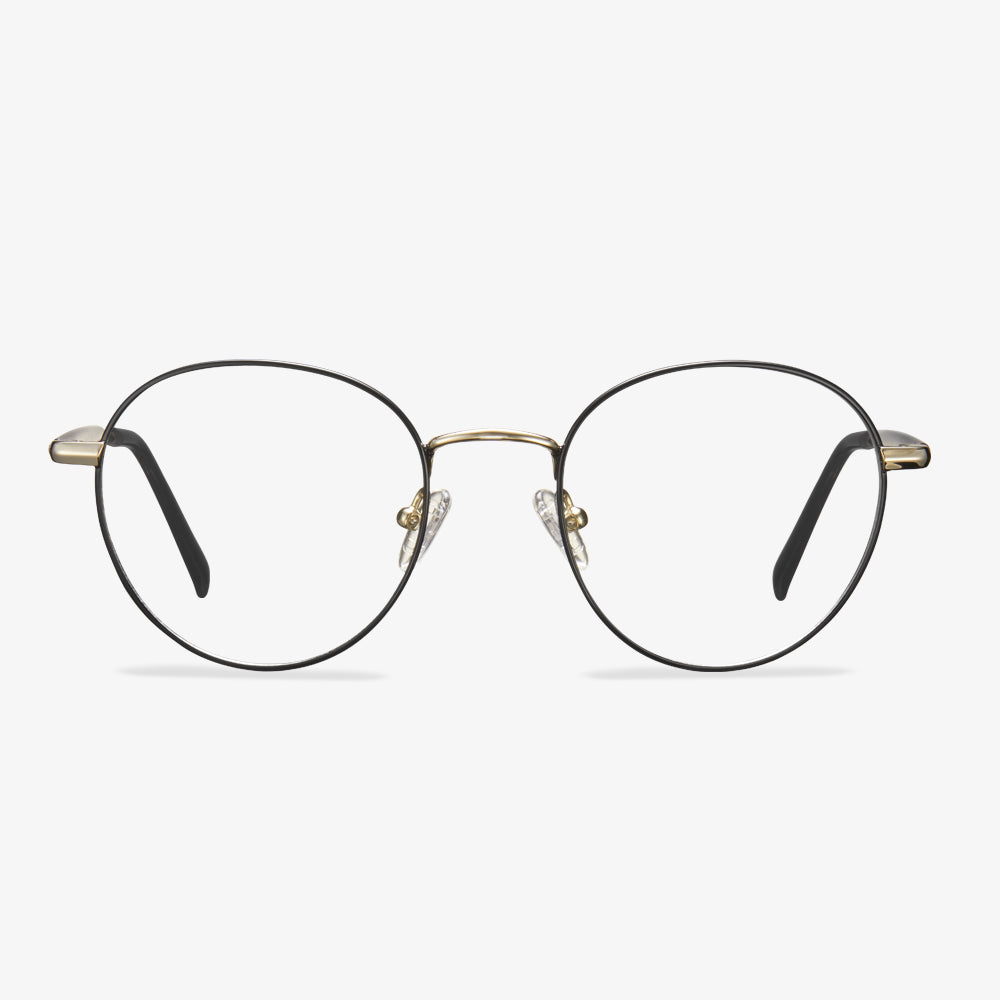
A 140 mm round in black acetate with a 44 mm lens and a 28 mm bridge — the widest bridge in this group, and the one to look at if your current frames slide down a narrow nose.
Frame width 140 mm · Lens 44 × 43 mm · Bridge 28 mm
The Retroz also shows where hardware sits on an acetate frame: reinforced hinges with decorative rivets. On a good acetate frame the rivets are functional, not cosmetic — they sit over the hinge pin so the load spreads into the material instead of pulling on a single hole.
Fit: acetate can be moved, and the bridge number tells you whether it needs to be
An optician can heat an acetate front and reshape the temples, the bridge angle and the way the frame sits behind the ear. Metal is adjusted by bending, which is a different kind of correction with a different failure mode. In practice acetate is the more forgiving material for the person whose head is between two sizes.
What acetate cannot fix is a bridge that is wrong for your nose. Moulded acetate has no separate pads to bend inward, so the fit depends on the bridge width and on how the frame rests on the sides of the nose. That is why two frames with the same 52 mm lens can feel completely different: one is built on an 18 mm bridge, the other on a 22 mm bridge, and only one of them will sit still on you.

A 141 mm square in Italian acetate with a 52 mm lens, 42 mm lens height and an 18 mm bridge — the narrow-bridge counterpart to the Retroz, for a nose that the wider frames slide off.
Frame width 141 mm · Lens 52 × 42 mm · Bridge 18 mm
The Albany listing describes the acetate as hypoallergenic, which is one of the material’s quieter advantages: it does not contain the nickel that metal frames are alloyed with, so the green-mark and itch problem that some wearers get from metal temples simply does not arise.
Weight: 20 g is not automatically better than 30 g
A lighter frame is easier to wear for eight hours and harder to keep in place. Acetate frames in this collection land between roughly 20 g and 30 g, and the number matters less than where the mass sits. A 20 g frame with a thin front and heavy temples will tip forward; a 28 g frame with a solid front and light temples will stay put. The only reliable measure is the front-to-temple balance, which you can feel in ten seconds by holding the frame by one temple and seeing whether the front dives.

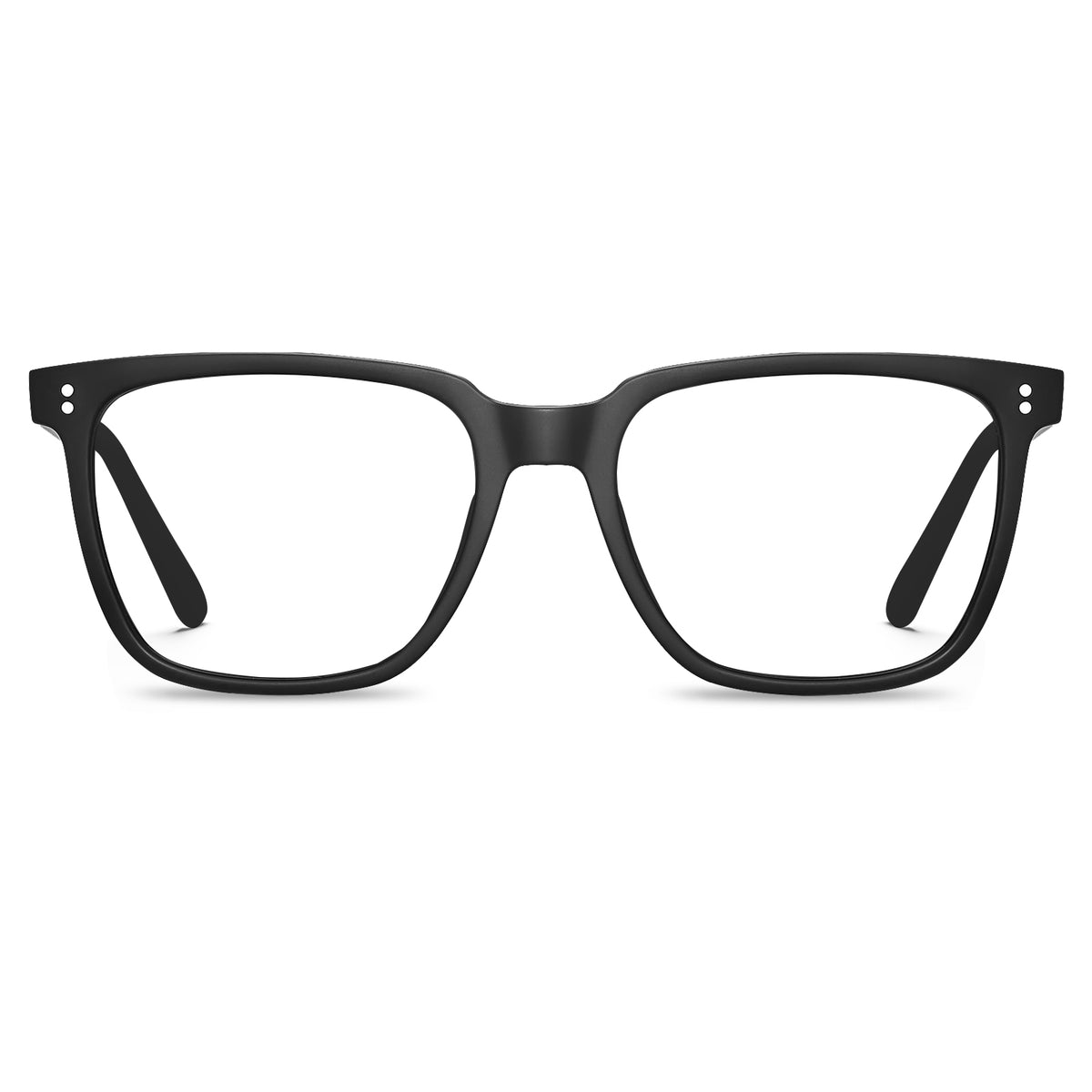
A 20 g full-rim rectangle — 142 mm wide, 53 mm lens, 40 mm lens height — with the lowest published weight in this group and a shallow lens that suits a shorter face.
Frame width 142 mm · Lens 53 × 40 mm · Bridge 19 mm
The 40 mm lens height is the part worth pausing on. It is deliberately shallow. A shallow lens cuts lens mass on a strong prescription, and it keeps the frame from covering the cheekbone. On the same face, a 46 mm deep lens in the same material will feel noticeably heavier even though the frame weighs the same on paper.
When acetate is the wrong answer
Three honest cases. If you want a rimless look, acetate cannot give it to you — there is nothing to drill into at the edge. If the frames are for sport, a metal or hybrid frame with sprung temples will survive knocks that would chip a polished acetate edge. And if your prescription sits at the top of the range and your priority is the thinnest possible appearance, a high-index lens in a small metal frame will beat a high-index lens in a large acetate one.
The fix in the second case is not always to leave acetate. It is to pick an acetate frame that borrows metal’s tricks — a wire core inside the temple, spring-loaded hinges, and separate adjustable nose pads where the design allows them.

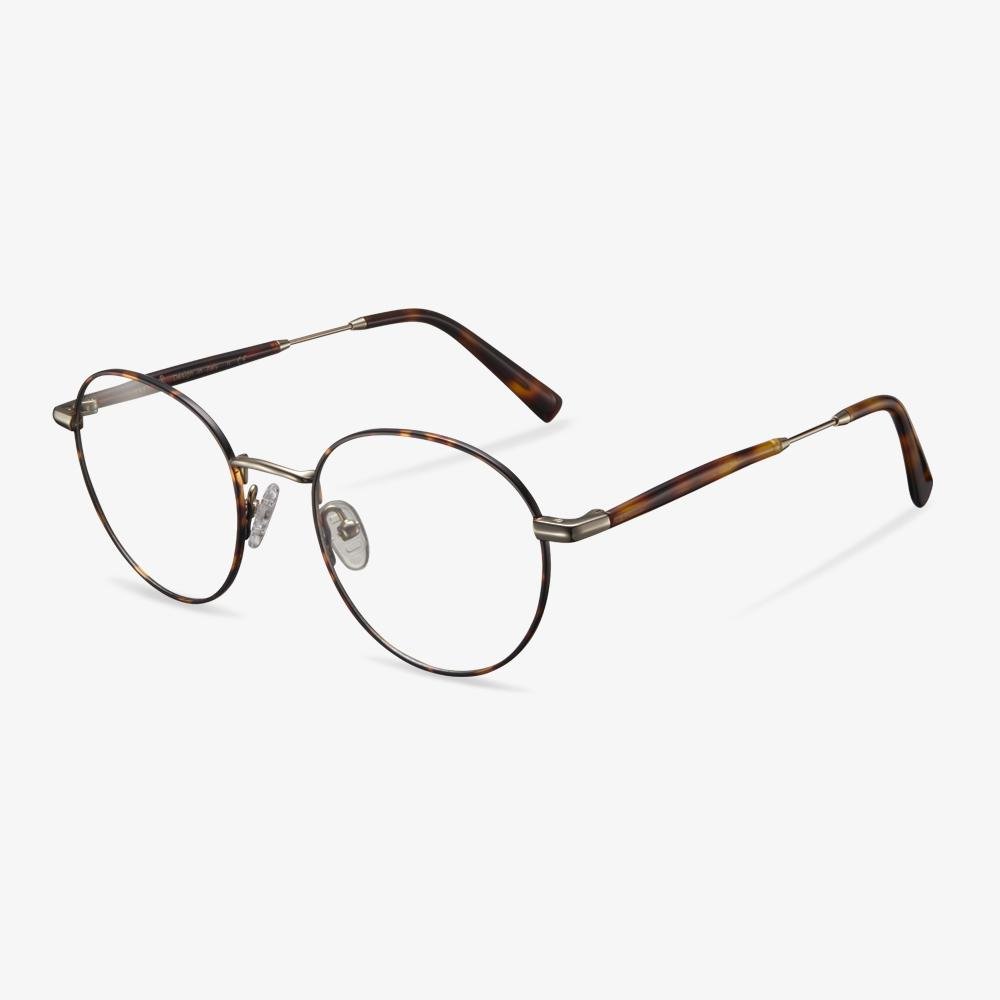
A 140 mm retro square in imported Italian acetate with gemstone-polished edges, plus metal wire-core temples, spring-loaded hinges and adjustable nose pads — an acetate frame engineered like a technical one.
Frame width 140 mm · Lens 50 × 43 mm · Bridge 19 mm
That combination is why the Downey is the frame we suggest to people who like the look of acetate but have been burned by a pair that loosened at the hinge or slid down the nose. The temples keep their shape because there is metal inside them; the pads can be moved; the front is still acetate, so the lens edge is still covered. If you are choosing lens types for a frame like this, the options are laid out on our lenses page.
Four numbers to check before you order
Frame width is the first. Take a pair that fits, measure across the front from hinge to hinge, and stay within about two millimetres. Lens width and lens height come next: width sets how the frame reads on your face, height decides how much of your field of view is framed and how heavy a strong lens becomes.
- Frame width — match your current pair within 2 mm; the five frames above run from 136 mm to 142 mm.
- Lens width and height — 44 mm wide with 43 mm height is a small round; 57 mm wide with 50 mm height is an oversized square.
- Bridge — 16 mm to 28 mm exists in this collection alone; a difference of 4 mm changes where the frame sits more than any other number.
- Pupillary distance — the one number you cannot read off the frame. Measure it once and keep it; the method is in how to measure frame size.
If you have never read a frame measurement out loud, our walkthrough on how to measure eyeglasses size covers the temple print, the mirror check and the two places people usually get it wrong.
Where to start
If you want the material with the most room to hide a lens edge and the most colour to choose from, start with acetate eyeglasses and filter by shape. If you are still deciding between acetate and a thinner rim, browse all eyeglasses side by side — the difference is obvious in the thumbnails once you know to look at rim depth. And if you are replacing a pair that you liked but that never quite fit, the darker, slightly larger builds in eyeglasses for men are the closest match to that look.
One last thing worth saying plainly: acetate is not automatically better than metal. It is better at covering a lens edge, holding colour and absorbing an adjustment. Metal is better at disappearing. The mistake is buying one material for the other material’s job.